In 1914, Martin Brady was living in Coleford, where he worked as a cook. He signed on with RGA on 21 November 1914 in Bristol.
He deserted from Plymouth on 28 January 1915 and was listed as a deserter in the Police Gazette on 16 February 1915. A court of enquiry was held on 26 February 1915 to discuss his case and to make a list of his belongings.
Martin Brady’s WW1 Record (Ancestry)
There is no reference to a Martin Brady being born in Gloucestershire or in online records that follow his desertion. He has a surname that is common in Ireland, so it is possible he escaped to Ireland, where he would find it much easier to avoid detection by the authorities.
The surname Brady primarily originates from Ireland, derived from the Gaelic Ó Brádaigh or Mac Brádaigh, translating to “descendant of” or “son of” Brádach
William Lewis was born in Minchinhampton in 1886, the son of an agricultural labourer. He married Rosina Gardiner in July 1911. Rosina already had a daughter, Winifred, from a previous relationship. The family then moved to the Forest so William could get better-paid work in the mines. At some stage, after this Wiliam joined the military.
In May 1918, Rosina Lewis from Ruardean Hill was sent to prison for seven days for aiding her husband, William, a sapper in the Royal Engineers, to desert. This was not the first time William had deserted while on home leave; on three occasions in the past, he had to be fetched by a military escort. He was due back in France in February, but did not arrive and had apparently disappeared. Eventually, a thorough search was made of his house and William was found sewn up inside the mattress cover on which his mother and four children were lying. He was arrested and returned to the trenches.[1] Rosina struggled to cope and was forced to enter the workhouse with her four children for a short period in the Autumn of 1918.
The Lewis family survived the war but not the poverty of post war Britain. William returned to work as a labourer at Foxes Bridge colliery near Cinderford, and by 1921, the family included six children. Labourers in Forest collieries were very badly paid compared to some of the more skilled workers who were on piece rates or were craftsmen and so the family struggled to feed their children.
In 1921, the response from the government and the owners to a depression in the coal trade was to allow ruthless competition to take its toll. They argued they had no alternative but to resolve the economic crisis in the coal industry by radically reducing labour costs, translated into wage cuts of up to 50 per cent. The miners refused to go to work under these new terms and downed tools. As a result, on 31 March 1921, one million British miners, including many war veterans, were locked out of their pits; this included over 6,000 miners from the Forest of Dean. After three months, the miners returned to work defeated and had to accept the severe wage cuts, while others became unemployed.
In July 1921, William was caught stealing four cabbages from Westbury Court Gardens valued at one shilling. Soon after, William and Rosina were brought to court, charged with neglecting their children, despite the court acknowledging they were well nourished. The parents were both sentenced to two months in prison and the children were taken into care. In addition, William was fined 20s for the theft of the cabbages.[2]
Rosina’s fourteen-year-old daughter Winifred died in 1922. Rosina died in 1927, aged just forty.
Oliver Brown was born in Cinderford in July 1890, the son of George and Mary Brown. He worked as a labourer and a miner in several collieries in the East Dean area. He volunteered in March 1915, but in September 1915, he deserted and disappeared. He somehow managed to survive clandestinely for over a year. He turned up later in Colchester, enlisted under the name of Travers and was killed in action in April 1917.
Any soldier serving under a fictitious name was committing an offence called fraudulent enlistment. This includes men who lie on their attestation forms about having previously been in the armed forces. However, only about 2000 men faced a tribunal for fraudulent enlistment.
In its project Alias, the Western Front Association has studied the existing pension records cards for World War One soldiers and discovered that about 10 000 soldiers killed in the war had pension cards which revealed they were serving under a name other than their own. Sometimes the records reveal that these men had a history of using several names and had enlisted in several different regiments.
This is only the tip of the iceberg, as the pension records only list casualties who had dependents who were able to claim a pension. The unknown figure, which includes those men serving under a name other than their own who survived the war and those who were killed during the war without dependents, must be very much higher than this.
Men had a range of reasons for enlisting under a false name. Deserters, for example, might rejoin in a different regiment to escape difficult circumstances such as conflict with officers, bullying, or dissatisfaction with where they were deployed. Some may have left temporarily due to personal or family issues and then enlisted elsewhere to avoid punishment for desertion, or because they found life on the run unsustainable. In other cases, individuals moved between branches of service, such as from the army to the navy, or vice versa.
Project Alias
Project Alias has produced some quite revealing findings about soldiers who served under names other than their own, and it shows this was both more common and more complex than previously understood.
1) The scale of alias use was much larger than expected
Before the project, the Commonwealth War Graves Commission had identified about 3,500 soldiers who served under an alias.
Project Alias expanded this to nearly 10,000 individuals
That’s roughly a 300% increase in known cases
This demonstrates that serving under a different name was not rare—it was a significant phenomenon in the First World War.
2) Many soldiers effectively had “dual identities” in records
The research found that:
Soldiers often had two parallel sets of records—one under their real name and one under the alias
In some cases, records were split across systems, meaning no single search would reveal the full service history
Project Alias addressed this by linking both identities so researchers can now find all records regardless of which name is used.
3) Not all “different names” were true aliases
A key finding is that multiple names don’t always mean deliberate deception. The project identified several categories:
Genuine aliases (intentional false names used at enlistment)
Spelling variations or clerical errors (e.g. “McKay” vs “Mackie”)
Administrative corrections (names altered later by officials)
Ambiguous cases where it’s unclear if it’s an alias or an error
So, the raw numbers include a mix of true aliases and record inconsistencies.
4) Evidence of alias use is often embedded in official records
Project Alias confirmed that:
Pension records frequently include both real and alias names
Some explicitly state “alias” or “served as”
Others only hint at it (e.g. crossed-out names, “see also” references)
This means many aliases were known to authorities at the time, but not systematically indexed.
5) Some individuals used more than one alias
While less common, the project found cases of:
Soldiers with multiple alias names
Complex identity trails across several documents
This further complicates tracing individuals without cross-referenced data.
6) The findings highlight unresolved historical questions
Although Project Alias identified the names, it also raised new questions:
Why did so many men enlist under false names?
How many cases remain undetected (e.g. if the alias was never recorded)?
The Western Front Association itself notes that the motivations behind alias use are still an area for further research.
Project Alias shows that serving under a different name in WWI was:
Widespread (far beyond earlier estimates)
Often traceable but poorly indexed
Not always intentional—sometimes administrative or accidental
Some volunteers had second thoughts almost immediately after signing on. This was the case for Herbert Moyes and William Watkins, who worked as farm labourers in Awre. Moyes worked at Aram’s farm near Newnham and Watkins at Box farm, near Awre
The two men enlisted in the army at Gloucester on 31 August 1914 and were then sent to a camp at Salisbury Plain. However, after several days, they decided to leave and walked back to their homes in Awre. A couple of days later, a local policeman spotted Moyes and enquired if he had enlisted. Moyes replied that he had left the army and admitted having deserted, adding that after several days on Salisbury Plain, they “had had enough of it”. He then made several complaints about their treatment by the military authorities. The policeman then came across Watkins, who made a statement similar to Moyes. [1]
The men were remanded pending the arrival of a military escort to take them back to Salisbury. It is unclear what happened to Moyes, but Watkins was discharged from the military on 7 October 1914 based on a recommendation that he was “unlikely of becoming an efficient soldier”.[2]
In 1921, Watkins was still living in Awre and working as a Carter for a local farmer.[3]
The action of Moyes and Watkins was not unusual in the Autumn of 1914. Training conditions during the winter of 1914–15 were extremely poor. Recruitment had far outpaced the military’s ability to properly house, equip, and supply the new soldiers, forcing many to live in tents. Food was inadequate, uniforms were lacking, and proper weapons were scarce. Constant wet weather turned camps into muddy, unsanitary environments, leading to outbreaks of disease such as measles and viral meningitis. Over 100,000 men became ill enough to require hospital treatment in Britain that winter, and more than 700 died. This harsh reality was far removed from what many had expected, prompting some recruits to abandon their posts and return home.
An account of desertion during World War One on the home front in the UK is available as a book by Andrea Hetherington. The book provides backgound reading to place the case studies provided here in their social, economic, political and historical context.
Thanks to Julian Putkowski for his advice and for pointing me in the right direction.
A list of about 100 deserters from the Forest of Dean during the First World War is provided in the table below following this introduction to the topic.
Introduction
Desertion was a small strike against the monotony of the military machine, a brief holiday from routine. It was a tactic for a man to negotiate or manoeuvre his way through a war which was mostly beyond his immediate control and it was a tactic utilised by many thousands of men.[1]
Andrea Hetherington
During the First World War, desertion and absence without leave became increasingly common. Many volunteers reconsidered their decision to enlist once they realised they would be exposed to the horrors of trench warfare or when they returned home on leave, having experienced the brutal realities of the war. When conscription was introduced in 1916, thousands of men were compelled to fight. As a result, it was unsurprising that some chose to desert or ignore their call-up papers altogether.
Most of these men were captured or returned to their units voluntarily and served the majority of their time in the military with distinction. Some were involved in acts of bravery while fighting on the front line and others were wounded or killed.
Among these men were a considerable number from the Forest of Dean. So far, this study has identified around 100 men from the Forest who deserted or went absent from the army and navy during the First World War.
Under military law, a distinction was made between desertion and absence without leave based on the soldier’s intention. Desertion occurs when a person abandons their duty or post without permission with the intention of not returning to their unit. In contrast, absence without leave refers to a temporary absence without permission, but with the intention of returning to their unit.
Andrea Hetherington, in her book Deserters of the First World War, argues that desertion and absenteeism while at home were an everyday part of military life, were far more widespread than might be imagined and were also culturally accepted. She challenges the standpoint of some historians that the army was held together by deference and the willingness of soldiers to obey orders. She argues:
This deference is overstated. There were huge numbers of trade-union men in the armed forces and they did protest when conditions were deemed unacceptable. Demonstrations of disobedience took place on a large scale at various stages of the war, from the early stages of training to the demobilisation process. Sometimes this was a group action and sometimes it was an individual act. Deference was conditional: where an implied contract was breached, men withdrew their labour.[2]
Desertion was just one category of many acts of defiance. War-weariness and disillusionment in the British army manifested themselves in many other ways, including conscientious objection, insubordination, live-and-let-live, strikes, and mutinies.[3] The “live and let live” system was an unofficial arrangement, common during the First World War, where opposing troops developed informal agreements to avoid shooting at specific times to eat, collect the dead, or repair trenches.
The focus of this discussion will be on the majority of men who deserted from the home front and were subject to military law. However, there were a few sailors from the Forest who deserted from the navy during World War 1, and their treatment was slightly different under the King’s Regulations and Admiralty Instructions produced by the Admiralty.
The following case studies on this website track the life stories of some of these Forest men who deserted and seek to understand the reasons for their actions, how they survived and the consequences for themselves and their families.
Shot at Dawn
In their book Shot at Dawn, Julian Putkowski and Julian Sykes describe one of the most shameful and inglorious episodes in all British history: the executions by firing squad of 346 members of the British and Empire forces during the First World War. 266 were shot for desertion itself, the remaining 43 were shot for other military offences, including cowardice and mutiny.[4] Most of the men executed for desertion were caught while avoiding active service abroad. However, the death penalty exists for deserters, whether they had walked away from a trench in France or from a parade ground at home, as a designation of being on active service applied to both. Fourteen of the shot at dawn contingent were actually arrested in Britain, taken back across the channel, where they were court-martialled and shot.
Putkowski and Sykes demonstrate the ineptness, ignorance and unfairness of the British court martial system at the time, and how frequently condemned men were proved to have been formerly brave soldiers who had simply cracked under the pressure of trench warfare. These men were judicially killed as a lesson to other soldiers who, it was thought, might themselves crack or choose to desert. In the event, many of the victims went to their deaths with unbelievable courage and dignity, as eye-witness accounts in their book show.
Anthony Babington, in his book For the Sake of Example – Capital Courts-Martial 1914-1920, argues that:
Death did not come to them, random and abrupt, on the field of battle; it came with measured tread as the calculated climax of an archaic and macabre ritual carried out, supposedly, in the interests of discipline and morale. [4a1]
Further research into executions during the First World War has concluded that most executed soldiers appear to be those who the military authorities viewed as no longer capable of being a good soldier and so were expendable. Such soldiers were often suffering from shell shock, and/or may have repeatedly deserted. The military executed such soldiers at regular intervals just as a means of enforcing discipline. [4b]
The warning the military made by executing these men probably prevented thousands of men from deserting. Despite this, those executed represented a very small minority of men who decided to desert or go absent without leave. As the horrors of trench warfare took their toll, increasing numbers of men took the risk of execution and walked away from active service. Between August 1914 and March 1920, about 300,000 men were convicted of court-martial offences, including nearly 127,000 for desertion or absenteeism.[5]
Convictions by a court-martial for desertion or absenteeism (August 1914 and March 1920).[6]
Offence
Total
Abroad
Home
Desertion
38,630
7,361
31,269
Absenteeism
81,188
37,034
51,154
Total
126, 818
44,395
82, 423
According to these statistics, during the war, the overall desertion rate was about 1 in 100 men and the biggest group was those deserting or going absent while at home. However, in reality, the figure was much higher because not all the men deserting or going absent were court-martialled. This was because not all deserters were captured, and when they were, many cases were handled informally and resulted in lighter punishments from their commanding officers, meaning these cases are not reflected in the official figures. In addition, if a deserter signed a confession, then there was no need for a court-martial.
Motivations
Desertion began almost immediately after the declaration of war, often due to the poor conditions in the training camps. Recruitment had far outpaced the military’s ability to properly house, equip, and supply the new soldiers, forcing many to live in tents. Food was inadequate, uniforms were lacking, and proper weapons were scarce. Constant wet weather turned camps into muddy, unsanitary environments, leading to outbreaks of disease such as measles and viral meningitis. Over 100,000 men became ill enough to require hospital treatment in Britain in the autumn and winter of 1914/15, and more than 700 died.[7] This harsh reality was far removed from what many had expected, prompting some recruits to abandon their posts and return home.
As the war progressed, men began to desert for a whole variety of reasons. However, for each individual, it was often unclear what the primary motivation was to take this step.
Some may have been unaware of the seriousness of their actions and just wanted to extend their home leave to spend more time with their families. Perhaps they wanted to see a newborn child, stay home for a while after getting married, support a sick relative or attend a funeral.
Others would have been so traumatised by their experience at the front and, possibly suffering from shell shock, could not face the thought of returning and facing more death and violence.
Some may have felt marginalised by society, and so did not want to die in a war which they thought had nothing to do with them.
Many soldiers had addiction problems with alcohol and mental health issues and struggled to cope with going for long periods without a drink or the support of family and community.
Others had a history of conflict with the authorities as trade unionists or political activists and, often holding them in contempt, did not want to accept their orders from upper-class officers.
Some already had a history of criminality and imprisonment, and were well practised in deceiving the authorities, and found a better alternative to war by drifting into crime while escaping on the run.
After the declaration of the Armistice, many did not want to wait months to be formally demobilised, so they just left their camps and headed home.
However, in general, desertion and absenteeism were often an expression of a much wider anti-war sentiment, reflecting increasing war weariness as casualties mounted and opposition to the war grew.
Military Discipline
Military discipline during the First World War was harsh. In cases of minor infractions, a non-commissioned officer could order a soldier to perform unpleasant tasks, such as cleaning the latrines, or to attend extra parades.
If the offence was considered more severe, a soldier would have to appear before a company commander. In this case, a fine could be imposed or the soldier confined to barracks with fatigue duties, square bashing, or pack drills and loss of pay. If the offence was even more serious, the soldier had to appear before a commanding officer who could award him a sentence in a detention (military prison) or a Field Punishment for up to twenty-eight days. During the First World War, civilian prisons were sometimes converted for use as detention barracks.
Field punishment was introduced in 1881 following the abolition of flogging. It was a common punishment during the First World War. A commanding officer could award a Field Punishment for up to 28 days. Field punishments were a brutalising experience designed to humiliate the victim. The punishments involved forced and heavy labour while being continually harassed by NCOs and performing everything “at the double”, loss of pay, no cigarettes and a restricted diet. On having completed a sentence, a further spell could be awarded sequentially.
Field punishment No 1 also consisted of the convicted man being placed in fetters and handcuffs or similar restraints and attached to a fixed object, such as a gun wheel or a fence post, for up to two hours per day. It was brutally refined by the personnel responsible for inflicting the punishment and came to be known as the crucifixion. Field Punishment Number 2 involved the brutalising experience described in the above paragraph, but did not involve the use of crucifixion.
Court Martial
The final sanction for military offences was the court-martial. There were four types of court-martial. Only two of them, the general court martial and the field general court martial, were invested with the authority to sanction the death penalty. The district court martial could only impose a maximum sentence of two years in prison, and the regimental court martial tried less serious offences.
In all, between August 1914 and March 1920, 5,952 officers and 298,310 other ranks were court-martialled during the war. This amounts to just over 3% of the total number of men who joined the army. Of those tried, 89% were convicted; 8% acquitted; the rest were either convicted without the conviction being confirmed or with it being subsequently quashed. [8]
Of those convicted, 30% were for absence without leave; 15% for drunkenness; 14% for desertion (although only 3% were actually in the field at the time); 11% for insubordination; 11% for loss of army property, and the remaining 19% for various other crimes. The main punishments applied were: 3 months detention in a military prison, 24%; Field Punishment Number 1, 22%; Fines, 12%; 6 months detention, 10%; reduction in rank, 10% and Field Punishment Number 2, 8%.[9]
There were almost 138,000 district court martials on the home front for various offences compared to just over 3000 general court martials.[10] Most punishments varied from confinement to barracks or a period in military detention with loss of pay, or alternatively, Field Punishments for up to ninety days with loss of pay.[11]
The most common sentence for offences committed at home was military detention under very harsh conditions. During the First World War, just over a hundred thousand such sentences were handed down.[12] Sentences were reviewed by senior officers and were often reduced or remitted in order to return men to service more quickly.
During the First World War, under the provisions of the Army Act, some offences were punishable more severely if the soldier was on active service abroad. Execution by firing squad was reserved for desertion, theft, sleeping while on duty or hitting a senior officer. 3,000 men were ordered to be put to death during the war, and as we have seen of these, 309 were executed.[13]
Desertion and Absenteeism
Desertion was an offence under section 154 of the Army Act, 1881, for regular soldiers or section 15 of the Reserve Forces Act, 1882, for Territorials and later for men who had been transferred to the Army Reserves under the Military Service Act, 1916.
Both desertion and absenteeism could be tried by court-martial. A person charged with desertion could be found guilty of desertion, attempting to desert or being absent without leave. Likewise, a person charged with attempting to desert could be found guilty of desertion or being absent without leave.
A soldier arrested for desertion on the home front was most likely to appear before a district court martial, where the maximum punishment was two years’ military detention. In more serious cases, they had to go before a general court-martial where the punishments could be harsher and included the death penalty.
A much larger group of men than deserters were the absentees, who often failed to return to barracks after being on home leave. Some of these men were simply quickly arrested and sent back to their military unit and did not face a court-martial, so they do not appear on court-martial records.
Punishments for absenteeism were lighter than those for desertion and there was no death penalty for being absent without leave. A soldier convicted of desertion would have all his previous service wiped out. This could have severe consequences for a regular army soldier with a long service record. This was another vital distinction between the punishment for desertion and absenteeism.
A conviction of desertion could impact a soldier’s or his widow’s pension. First World War pensions for British soldiers were granted for disability or for widows. Pensions were based on the percentage of disability or rank, often requiring proof that conditions were caused or aggravated by military service.
Absentees were far less likely to face court-martial because company commanders had summary disciplinary powers that allowed them to impose a variety of punishments without resorting to imprisonment. Under these powers, an absentee could receive up to 28 days’ detention. Short sentences of up to seven days would normally be served in the barracks, but longer sentences would be served in one of the military detention centres located around the country.
Other possible penalties included field punishment, confinement to barracks, or loss of pay. Sentences of fewer than seven days were typically served in barracks cells, while longer terms were carried out in military detention centres located across the country.
Both deserters and absentees forfeited their pay for every day they were absent, as well as for any time spent in detention, undergoing field punishment, military detention, or held in civilian custody. They could also be charged for any missing issued kit and for the cost of an escort sent to retrieve them.
Court of Enquiry
In cases where absenteeism was less than 21 days, the case could be dealt with summarily by the commanding officer, who was required to take the circumstances into account. In these cases, the commanding officer could impose detention not exceeding 21 days or refer the case to a court-martial. However, in determining the sentence, the commanding officer had to consider the number of days absent. If the absenteeism exceeded seven days, the number of days in detention could not exceed the number of days absent.
Cases of longer periods were invariably dealt with by a court-martial. When a soldier was absent without leave for 21 clear days, a court of inquiry was assembled to consider what action to take. At the hearing, evidence would be given by witnesses with knowledge of the last known movements or sightings of the absentee. At the conclusion, a court may declare a soldier a deserter. However, this did not preclude the possibility of a charge of desertion being brought if the absentee was arrested within the 21 days. If the absent soldier did not afterwards surrender or was not apprehended, the record of the court of enquiry had the legal effect of a conviction by court-martial for desertion.[14]
A man absent for 21 days or more was usually reported to the civil authorities in the district in which he was last known to have resided, and a description of him was posted in the Police Gazette. Additional figures show that 146, 733 men were classified as deserters by the military because they were missing for longer than 21 days.[15] However, some of these were never captured or court-martialled. Throughout the war, the Police Gazette carried an average of about a thousand names in these lists every week, all wanted for absenteeism and desertion..
The Civil Courts
During the early years of the war, offenders who were apprehended by the civilian police were usually dealt with by the local magistrates and remanded before being handed over to the military, where they could be brought before a district court martial. In some cases, this was reported in the local newspapers. Jonathan Swan is his book, Law and War, explains this in more detail:
Desertion was an offence under section 154 of the Army Act, 1881, for regular soldiers or section 15 of the Reserve Forces Act, 1882, for Territorials and later for men who had been transferred to the Army Reserves under the Military Service Act, 1916.
Police constables were authorised to arrest anyone suspected of being a deserter and to take them to the magistrates’ court, and likewise, a justice of the peace could issue a warrant for such an arrest. The court had to be satisfied that the man was a deserter or absentee, either by evidence on oath or, more commonly, by confession, in which case he was to be remanded at the police station or local prison until he could be delivered into military custody.
The legal test to determine whether the soldier was a genuine deserter or merely absent without leave (in naval terms, a ‘straggler’ ) was carried out by the army or navy once the man was back at his unit or ship; the magistrates simply had to ensure that he was lawfully detained in civilian custody.
Regular soldiers who fell under section 154 of the Army Act faced no further civil penalty, but on conviction under section 15 of the Reserve Forces Act at the magistrates’ court, reservists could be sentenced to a fine not less than 40s and not more than £25, with the option of imprisonment in default. In practice, the courts were instructed to impose a fine which was then to be deducted from his Army pay – imprisonment in default would simply add a further delay to the man’s return to military duty. The standard fine was 40s, nearly six weeks’ pay. The magistrates were also allowed to recommend a reward, usually 5s, for the informant or arresting officer, payable by the Army Council.[16]
Clearly, there was the incentive of a reward for the police to devote their energies to tracking down deserters. When returned to the military, the decision whether to charge a soldier with desertion or absenteeism would rest with his commanding officer and the officer convening the court-martial, and would depend on the facts of the case, especially regarding any evidence of his intention to return. Later in 1917, the arrested soldier was just held in a police cell before being handed over to the military authorities, and so the newspaper reporting of arrested offenders ceased.
On the Run
Once a soldier or sailor made the decision to desert, they became an outlaw and some remained in that role for the rest of their lives. Deserters on the run had a variety of ways to survive in what was essentially a military state, with the additional hazard of police officers being offered awards for their capture. Many headed for their family homes and communities in the belief that they might find refuge there. Certainly, desertion on this scale required that there was a high degree of collusion from civilians on the home front. However, home was the first place the police looked and they often found deserters hiding in the most unusual places.
Helping or hiding a deserter was treated as a criminal offence. Under Section 153 of the Army Act. It was illegal to encourage a soldier to desert, assist in their escape, or shelter them afterwards. Families of deserters often faced severe consequences, even if they were not actively hiding them. The impact of the law was especially harsh on parents, who were protecting sons already wounded or who had lost other children in the war.
Those found guilty of helping a deserter could face up to six months’ imprisonment, with or without hard labour, and courts were quick to enforce these penalties. From August 1914 through to the end of the war, newspapers frequently reported cases of friends and family members being prosecuted for concealing deserters.
When a soldier deserted, his pay was immediately stopped, and the separation allowance provided to his wife and children was also withdrawn. This policy was intended to pressure the deserter into returning by placing his family under financial strain.
It was probably safer to avoid a family home, which meant that some deserters had to learn how to survive on the run by begging, petty theft and fraud. A popular way to survive was by pretending to be collecting for charity, preferably dressed in a bandage and in a uniform, not necessarily belonging to the deserter. Often, the uniforms could be traded on the open market, and an officer’s uniform was particularly effective. Farm animals, particularly horses, were very valuable as they could be stolen and sold at a nearby market. Bikes were often stolen for transport and then sold on and there was an illegal trade in diesel and petrol.
Some deserters were able to find work either with friendly employers who knew they were on the run but took the risk of employing them, or sometimes, deserters found work under a false name. However, employing a deserter was considered a serious offence and, depending on the jurisdiction, could be treated as aiding, harbouring, or concealing a person who had committed a capital military crime. An alternative strategy was to migrate abroad. Many chose to go to Ireland, where it was much easier to hide from the authorities, while some emigrated to America.
If deserters were caught after committing a civilian crime, they were brought before the magistrates and sometimes held on remand to appear before the Quarter Sessions. If found guilty of a civilian offence, they would be sentenced to a civilian prison, often with hard labour. Some told the courts what they wanted to hear, while others continued to defy authority. On completion of their sentence, they would then be handed over to the military authorities to face a possible court-martial.
Fraudulent Enlistment
Some found it difficult to survive on the run or changed their minds and enlisted again under a different name. Any soldier serving under a fictitious name was committing an offence called fraudulent enlistment. This includes men who lie on their attestation forms about having previously been in the armed forces.
In its project Alias, the Western Front Association has studied the existing pension records cards for First World War soldiers and discovered that about 10 000 soldiers killed in the war had pension cards which revealed they were serving under a name other than their own. Sometimes the records reveal that these men had a history of using several names and had enlisted in several different regiments.
This is only the tip of the iceberg, as the pension records only list casualties who had a dependent who was able to claim a pension. The unknown figure, which includes those men serving under a name other than their own who survived the war and those who were killed during the war without dependents, must be very much higher than 10,000. However, only about 2000 men faced a tribunal for fraudulent enlistment during the war.
Men had a range of reasons for enlisting under a false name. Deserters, for example, might join a different regiment to escape difficult circumstances such as conflict with officers, bullying, or dissatisfaction with where they were deployed. Some may have left temporarily due to personal or family issues and then enlisted elsewhere to avoid punishment for desertion, or because they found life on the run unsustainable. In some cases, individuals moved between branches of service, such as from the army to the navy, or vice versa.
Doing a Blighty
Faced with the prospect of being killed or permanently disabled, soldiers sometimes hoped that they would receive what was known as a blighty wound and be sent back home. There were some cases where soldiers shot themselves in an attempt to avoid being sent to the frontline or to end their time on the frontline. Self-inflicted wounds (SIW) were a capital offence, and if discovered, a man found guilty of this faced execution by firing-squad. A total of 3,894 men in the British Army were convicted of SIW. None of these men was executed, but they all served periods in prison.[17]
There was also a sharp rise in sexually transmitted diseases. Many armies regularly issued condoms to soldiers going on leave, though these measures were often ineffective. In some cases, soldiers did not even try to avoid infection. Infected prostitutes could earn more than healthy ones, as they attracted men seeking illness as a way to escape front-line duty.
One of the most disturbing manifestations of this was the trade in gonococcal discharge, which soldiers would deliberately apply to themselves in hopes of being hospitalised. In extreme cases, some even exposed their eyes to infection, frequently resulting in permanent blindness. A similar and equally grim practice involved the use of phlegm from tuberculosis sufferers. By the summer of 1917, around 20 per cent of Allied soldiers visiting Paris had contracted infections.[18]
Another strategy for avoiding combat in the First World War was called ‘Live and let Live’. This was an unofficial, tacit system of truces between opposing trench soldiers, particularly on the Western Front, where both sides intentionally restricted violence. Soldiers often agreed not to attack during rest, meals, or sanitation periods, creating localised lulls in fighting to manage the brutal conditions.
Conscription
The introduction of conscription in 1916 led to the calling up of thousands of men, most of whom had already decided they did not want to volunteer to join the military. Approximately 2.5 million men were conscripted into the British Army during the First World War following the introduction of the Military Service Act in 1916. About 5 million men joined in total, which meant conscripts made up roughly 50% of the army’s total manpower by 1918.
However, it is clear from the hundreds of appeals to military tribunals that filled the local newspapers from 1916 onwards that many conscripts desperately tried to avoid being sent to fight. From March 1916, local papers in the Forest of Dean carried accounts of hundreds of military tribunals where conscripts applied for exemption from military service, mainly on the grounds of occupation or family circumstances. In addition, the local tribunal could grant an absolute, partial, conditional or temporary exemption from military service on the grounds of conscience.
Nationally, about 20,000 men were awarded the status of conscientious objectors and were able to avoid military combat by providing the authorities at military tribunals with an acceptable moral base for their appeal, usually based on political or religious grounds. Among these were 28 men from the Forest of Dean.
Exemption from combatant service on grounds of conscience was usually conditional on being engaged in work of national importance or in the form of military service in organisations such as the Royal Army Medical Corps or the Non-Combatant Corps (NCC). If an applicant wanted to apply for exemption, he had to send a written statement arguing his case before the date of the tribunal. At the hearing, the chairman could then cross-examine the applicant to ascertain if his convictions were genuine. There were a huge number of cases before each tribunal, so the hearing could be over in a few minutes before a decision was made.
Each tribunal had a military representative whose job was to speak on behalf of the army and was usually opposed to any application for exemption by conscientious objectors. He was not a member of the tribunal, so he was not meant to be a party to the decision-making. The tribunal was made up of members of the local establishment, such as clergymen, businessmen, mine owners and councillors and trade union representatives.
Although these men were supposed to be impartial, they were usually very patriotic and had little sympathy or understanding of people who were against the war. Most tribunal members refused to accept that the new law gave them powers to grant absolute exemption, with no conditions, from military service. Tribunal members often saw their role as making sure as many men as possible enlisted in the army. This resulted in the frequent abandonment of all sense of judicial impartiality. So, in practice, it was very difficult to convince the tribunal in an application on the grounds of conscience.
In these circumstances, it was particularly hard for young men appearing before a tribunal, as it was necessary to explain in detail the moral, political or religious grounds for making an application for exemption. Most young men in the Forest of Dean would have had little experience of public speaking or the opportunity to express deeply held beliefs. Appearing before senior members of the community would have been a nerve-wracking, confusing and intimidating experience for any young person. This led to some young men failing to seek exemption even when they had a genuine reason to avoid conscription.
This was made worse because tribunal members often viewed young Forest men as little more than delinquents. In October 1916, the Gloucestershire Chronicle warned that miners not fully committed to the war effort could have their exemption on the grounds of occupation removed:
The output of the whole coal field has suffered considerably in the last two weeks, and every special effort will be necessary to make up the loss. There is no need to enlarge upon the plain warnings as to the liability of habitual absentees, of eligible age for military service, but it will be well for such delinquents to remember that their inattention is being taken strict note of by the military authorities.[19]
Call Up Papers
Many men, some of whom were conscientious objectors, simply ignored the call-up papers. Some seemed to be unaware of the seriousness of their actions, while others just disappeared.
At the end of March 1916, the cabinet sent a memo that stated that of 193 891 men who had been called up at that stage, 57,416 had failed to turn up to barracks. Another estimate gives a figure that by July 1916, 93,000 (30%) of those called up after the introduction of conscription in 1916 failed to report to barracks.[20] The number of men who did not respond to their call-up under the Military Service Act suggests that a substantial segment of the population was unwilling to participate in the war.
The Police Gazette now introduced a new category in their weekly lists of men and included men who had failed to answer their call-up papers. This was a separate section and it usually was made up of about a thousand names per edition, in addition to those who were listed as wanted for desertion and absenteeism.
Most of these absentees were quickly rounded up by the authorities and the arresting officer awarded their 5s reward. They were dealt with as absentees under the Reserve Forces Act and were usually fined 40s and detained in custody to await military escort. However, some were never found, often surviving using clandestine networks created by the anti-war movement, which moved absentees from safe houses to hiding places and vice versa and had links with Ireland and America.
Significantly, the high rate of desertion did not increase after the introduction of conscription, which implies that the existing volunteers were equally keen to avoid combat as the new conscripts.
Demobilisation
Immediately after the armistice, protests erupted in the army and navy over the issues of demobilisation, military discipline and drafting to Russia. Two days after the armistice, 7,000 soldiers marched from their base at Shoreham to Brighton and demanded to be released from the army.[21] There were strikes and demonstrations by discontented servicemen at Biggin Hill, Aldershot, Winchester, Lymington, Bristol, Milford Haven, Plymouth, Falmouth, Felixstowe, Bedford, Kettering, Leeds, Manchester, Blackpool, Edinburgh, the Isle of Wight, Lewes, Southwick, Osterley Park, Bromley, Park Royal and Kempton Park.[22]
The protests continued into early 1919 and in some cases developed into outright mutiny as soldiers disobeyed orders, took over bases and even arranged their own demobilisation. On 3 January, the Daily Herald reported that in Folkestone:
Ten thousand soldiers marched through the town, held a mass meeting at which they formed a soldiers’ union, elected 140 men to act as clerks, took over the demobilisation department, and in one day issued all the necessary pass papers, ration books and railway warrants for the whole camp. By Sunday, the camp was clear.[23]
At the end of January, the trouble spread to Calais, where up to 20,000 men were involved in demobilisation protests and linked up with striking French railway workers closing the ports to prevent the movement of troops.[24] In mid-January, sailors on several ships mutinied and refused to be sent to fight against the Red Army in the Russian civil war.[25]
In most cases, the scale of the protests meant that the authorities had no choice but to concede to the men’s demands. On 8 February, the loyalty of professional soldiers in the Grenadier Guards and the Household Cavalry was tested when they were ordered to fix bayonets and confront over one thousand armed soldiers who were marching towards parliament, having refused to board trains to France. Churchill wrote later: “I remained in my room, a prey to anxiety”.[26] During January and February, some estimates have up to 100,000 men directly or indirectly involved in these disturbances.[27]
Men continued to desert and the figure from the Police Gazette in January 1919 is 2313. Throughout 1919, the desertion rate continued at an average of 1657 a month.
Detention
At the date of the armistice, there were 3,500 men in detention for military offences, including desertion.[28] However, for most of these men, there would be no early release. despite prison protests and calls for an amnesty from families, politicians, and veterans’ groups.
This was particularly hard on those sentenced to penal servitude. This meant their sentences were longer and they had to perform hard labour in specific “convict prisons” such as Dartmoor and Portland. In August 1919, a total of 406 soldiers were still serving sentences of penal servitude, and of these, 216 had been sentenced for desertion, and 2 were absentees.[29]
Over the next two years, most of the prisoners had their sentences reduced and were gradually released. As for those still at large, the authorities gradually lost interest and by July 1920, no action would be taken against any deserter even if they requested their discharge papers, pension and back pay owing to them, although often such requests were refused. Men tracked back to their communities and families, with many coming back from Ireland. Generally speaking, they were welcomed and often treated better than conscientious objectors.
Conclusion
For some men, desertion or absenteeism defined their entire military service, bringing severe consequences such as imprisonment or even execution. Sometimes it was in response to the unimaginable horror and brutality of trench warfare and for others it was a practical response to immediate hardship or need to support a family at home. And for others, it was a rational choice between life and death. There was no general pardon for First World War deserters.
[1] Andrea Hetherington, Deserters of the First World War, The Home Front, Yorkshire: Pen and Sword, 2023, 172.
[2] Hetherington, Deserters of the First World War.
[3] David Englander and James Osborne, “Jack, Tommy, and Henry Dubb: The Armed Forces and the Working Class”, The Historical Journal, 21, (1978) 593-621 and Tony Ashworth, Trench Warfare, 1914 -1918, The Live and Let Live System, (London: Pan Books, 1980) and Tony Ashworth, “The Sociology of Trench Warfare 1914-18“, The British Journal of Sociology, Vol. 19, No. 4 (December 1968) 407-423.
[4] Julian Putkowski and Julian Sykes, Shot At Dawn: Executions in World War One by authority of the British Army Act, London: Leo Cooper, 1996.
[4a1] Anthony Babington, For the Sake of Example – Capital Courts-Martial 1914-1920, Leo Cooper 1999) pXI.
[4b] People’s Histreh: 103 Foresters: Mutinies and death sentences in the local regiment – 1914-18.
[5] Statistics of the military Effort of the British Empire during the Great War, 1914-1920, London: HMSO, 1922.
[6] Statistics of the military Effort of the British Empire
[7] Hetherington, Deserters of the First World War, 20.
[8] Statistics of the military Effort of the British Empire
[20] I. F. W. Beckett, The real unknown army. British conscripts 1916-1990, The Great War, 1914-1918, The Illustrated Journal of First World War History, 2 (1988) 4-13.
[22] G. Dallas and D. Gill, The Unknown Army, Mutinies in the British Army in World War One (London: Verso, 1985) and Simon Webb, 1919,Britain’s Year of Revolution (Barnsley: Pen and Sword, 2016) 43.
[28] Hetherington, Deserters of the First World War, 156.
[29] Hetherington, Deserters of the First World War, 157.
Table
The men in the following list are itemised chronologically, based on date of desertion. They are just a few of those so far identified. Details of others will be added as their stories are uncovered. Further details of some of these men are listed in bold on this WordPress site. More to follow.
Some of the men from the Forest of Dean who deserted or went absent without leave between August 1914 and December 1918.
Henry Thomas Parry was born in Newnham in July 1880, the son of a blacksmith, Frederick Parry. In July 1874, Frederick was sentenced to one month’s hard labour for the theft of a florin. In 1876, Frederick was prosecuted for failing to maintain his wife and child, who were inmates of the Westbury workhouse. The couple had only been married for one year. He was ordered to pay 6s a week.[1]
In time, Frederick’s neglect and violence increased. He became a habitual drunkard and he repeatedly assaulted his wife. As a result, he was often up before the local magistrates. It is quite possible that he also abused his children. In November 1889, Frederick Parry assaulted his wife so badly that she was seriously injured and forced to leave their house and enter the workhouse with her children.[2]However, by 1891, the family were living together again.
Possibly because of the violence from his father, by the age of sixteen, Henry had left home and ended up living in London. In August 1896, he was in Pentonville prison serving one month’s hard labour for theft of a travelling bag.
Henry joined the Pembroke Artillery Militia in 1898. The British Militia was the principal military reserve force for internal security duties and for defence against external invasions. It was made up of non-professional soldiers who signed on for a term of service, which committed them to serve for training or duty if called up.
Henry deserted on 15 May 1899 and went on the run, surviving by committing a series of crimes and was usually described in his criminal records as of no fixed abode. His prison records also describe him as a fireman, a stoker or a labourer and so, between 1902 and 1907, he may have gained some work working on the railways or in shipping.
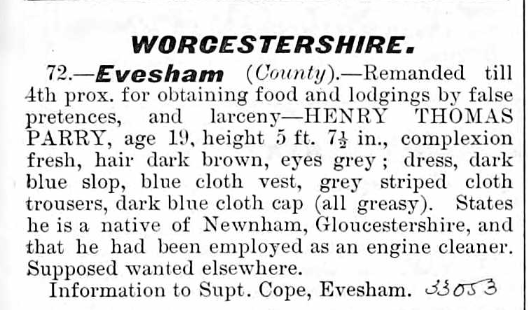
Police Gazette June 1899.
Place of Conviction
Date
Offence
Sentence
Marylebone
19/08/1896
Theft of a travelling bag
One month’s hard labour in a prison
Evesham
4/07/1899
Theft of a watch
Two months’ hard labour in a prison
Blackwood
8/09/1899
Theft of a watch and chain
One month’s hard labour in a prison
Glamorgan
17/03/1900
Theft of watches (3 charges)
9, 9, 9 months’ hard labour in a prison concurrently
Newport
17/12/1900
Theft of trousers and watches, etc (2 charges)
3, 3 months’ hard labour in a prison concurrently.
Newport
02/09/1901
Theft of 2 watches, etc
6 months’ hard labour in a prison
Cardiff
17/10/1901
Theft of clothes, purse and money
12 months’ hard labour in a prison. Concurrent with the above.
Newport
13/02/1907
Obtaining food and lodgings by false pretences (3 Charges)
3 months’ hard labour in a prison
Gloucester
21/10/1908
Theft of a cycle
6 months’ hard labour in a prison
Henry’s father died in July 1899. In the early 1900s, Parry started a relationship with Eliza Brown from Awre, who already had a child, Ernest, born in 1899. They had three illegitimate children: Gladys, born in 1902 in London, Ivor, born in 1908 in London and Lily, born in 1913 in Yorkshire (when Parry was described as a painter).
Parry was unable to support his family while in prison. He was admitted to Chepstow workhouse on 24 January 1908. In 1911, he was back in Newnham and living with his mother and siblings, but listed as married and as a labourer. At this time, Eliza was living in a house in Newnham with Gladys and Ivor and was described as single and working as a charwoman. In 1912, Eliza, Gladys and Ivor were admitted to the workhouse.
In 1914, Parry was living with Eliza and the three children in Barry and working as a marine stoker. On 8 December 1914, Parry joined the 16th Battalion, Welsh Regiment. However, he was discharged on 21 January 1915 because the military authorities deemed that he was unlikely to become “an efficient soldier”.
He married Eliza Brown on 24 October 1915. It appears that at some point he rejoined the army as a member of the Royal Engineers Inland Waterways Transport Corps.
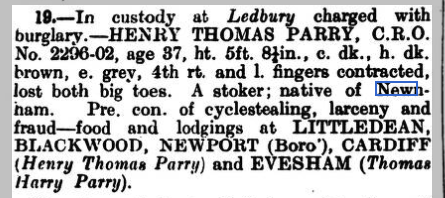
However, on 27 February 1917, Henry Parry, a stoker from Newnham, was listed as a deserter in the Police Gazette.
Police Gazette 23 March 1917
A few weeks later, he was arrested and charged with burglary and theft of £8. He was described in court as a well-dressed man living on City Road in Bristol. When he was arrested, he said:
“What? Breaking in; I know nothing about it.”
He was brought before the magistrates the next day and further remanded to appear at the next Quarter Sessions. He told the bench that:
he was very sorry. He had been working at Bristol but, wanting a change, he went to Ledbury with the intention of going to Hereford to work. He was invalided home several times, and had been put on as a substitute. He said that he would do all in his power to pay the lady back. He had been drinking heavily from the Saturday till the Tuesday night.[3]
At Hereford Quarter sessions, he was bound over to come for judgment within 12 months if called upon. The military authorities undertook to take charge of him.
It is unclear if he survived the war. However, a Henry Thomas Parry, born in 1881 in Gloucester, signed on the merchant navy in 1929. It is unclear if this is the same man.
In 1921, Eliza was living with Ivor and Lily near Ledbury and described as married as a charwoman. She died near Ledbury in January 1939. Her son Earnest gained work as an Air Ministry policeman but then joined the Royal Navy during World War Two and was killed at sea in 1940. Gladys worked as a domestic servant. Ivor joined the Royal Navy in 1926 and served during World War Two. Lily worked in a factory near Ledbury.
Thomas Nelmes was born in Coleford in 1876, the son of Mary Ann Nelmes, who was single. He was brought up by his grandmother Jane Nelmes, who kept a lodging house near Coleford. He started working in the mines after he left school. Jane died in 1906, leaving him with no close family. In 1899 and 1905, he was convicted of drunkenness and in 1910, he was found guilty of using obscene language.
In April 1914, Nelmes was convicted of housebreaking and stealing beef, butter and bread in Shropshire. He was arrested at the workhouse in Market Drayton and described as a tramp, but considered by the police to be of good character and was therefore bound over and discharged.
King’s Liverpool Regiment.
Nelmes enlisted in the Army at Horfield in Bristol in April 1916 and joined the King’s Liverpool Regiment.
The King’s Liverpool Regiment played a notable role in the Battle of Arras, which took place between April and May 1917 as part of a larger British offensive on the Western Front. It was likely that Nelmes was involved in the opening attack, which included advancing towards the German lines behind a creeping artillery barrage. This tactic helped them capture sections of German front-line trenches near Arras. Units of the regiment were involved in actions around strategic points such as the outskirts of Arras and nearby villages. These areas were heavily defended, and progress often came at a high cost.
Siegfried Sassoon’s experience of the Battle of Arras possibly exceeded in horror even the Somme campaign of the previous year.
The dead bodies lying about the trenches & in the open are beyond description…. Our shelling of the line—& subsequent bombing etc—has left a number of mangled Germans—they will haunt me till I die.’
On 16 April, while leading an attack on the Hindenburg Line, Sassoon was wounded by a rifle bullet which narrowly missed his spine and jugular; he was evacuated to a hospital in England.
Desertion
Nelmes was also probably traumatised by the experience and deserted in early May 1917, within a month of active service. This was a very risky decision. Julian Putkowsku and Julian Sykes, in their book Shot at Dawn, identify six men from King’s Liverpool Regiment executed by the British Army for desertion while on active service abroad btween July 1916 and May 1918.
Somehow, Nelmes made his way back to England and tried to survive by petty crime. On 24 May 1917, Nelmes broke into a house in Highnam, near Gloucester and stole five silver bangles. He then sold one of the bangles to a man who had agreed to give him a cup of tea. He told the man that he had been gassed in France and was given the bangles by a comrade on the Somme. He later sold the remaining bangles to a watchmaker. He was arrested at his lodgings in Newent. He pleaded guilty at his trial on 12 June. His character, whilst in the army, was described as bad. He was imprisoned with hard labour for four months.[1]
On release from prison, Nelmes was handed back to the military and appeared before a court-martial on 1 November 1917 and convicted of desertion. He was sentenced to six months in a military prison, remitted to eighty-four days.[2]
As his sentence was remitted and the army was very short of men, it was likely that on his release, he was returned to active service abroad. However, it is unclear what happened to Nelmes when he was released from prison.
Place of Conviction
Date
Offence
Sentence
Coleford
28/03/1899
Drunk in charge of a horse and cart
Fined 2s 6d plus costs
Coleford
3/05/1905
drunkenness
Fined 2s 6d plus 4s costs
Coleford
2/08/1910
Abusive Language
Fined 5s plus costs
Shrewsbury
7/04/1914
Housebreaking and larceny
Bound Over and discharged
Gloucester
24/5/1917
Housebreaking and larceny
Prison with hard labour for four months
Thomas E Nelmes died in Ross in 1920
[1]Gloucester Journal 9 June 1917 and Gloucester Journal 16 June 1917.
[2] Fold3
Most of Albert Goode’s military records have been lost. However, the Gloucester Journal refers to him being arrested for being absent without leave for just one week in early 1916 and reports on his serious injuries in 1918.
Albert Goode was born in Viney Hill, near Lydney, in 1882. He was the only child of William and Emma Goode. Both father and son worked in the mines at New Fancy colliery. Albert Goode had a difficult childhood and became the sole breadwinner for the family, having to care for his ageing mother and father. His mother died in February 1912 and his father died in January 1915.
He was often in trouble with the police for minor offences associated with his use of abusive language and alcohol. Between 1903 and 1914, he appeared in court nineteen times and was imprisoned for 14 days on 27 October 1908 for using abusive language.[1] It is possible he had Tourette’s syndrome.[2]
Place of Conviction
Date
Offence
Sentence
Coleford
16/6/03
Drunkenness
Fined 2s 6d plus costs
Littledean
10/ 2/04
Abusive Language
Fined 10s plus costs
Littledean
24/05/04
Abusive Language
Fined 10s plus costs
Littledean
24/02/05
Abusive Language
Fined 10s plus costs
Coleford
9/10/06
Drunkenness
Fined 2s 6d plus costs
Coleford
5/02/07
Drunkenness
Fined 7s 6d plus costs
Coleford
23/07/07
Refusing to Quit
Fined £1 plus costs
Coleford
24/09/07
Abusive Language
Fined 5s plus costs
Coleford
27/10/08
Abusive Language
14 days in prison
Littledean
21/07/10
Drunkenness
Coleford
26/04/11
Abusive Language
Fined 7s 6d plus costs
Coleford
16/08/11
Abusive Language
Fined 12s 6d plus costs
Coleford
3/01/12
Drunk and disorderly
Fined 10s plus costs
Coleford
8/06/12
Drunk and disorderly
Fined 15s plus costs
Coleford
08/02/13
Drunkenness (found drunk on the side of the road
Fined £1 plus costs
Coleford
27/09/13
Drunk and disorderly
Fined £1 plus costs
Coleford
21/10/13
Abusive Language
Fined £1 plus costs
Coleford
15/12/13
Abusive Language
Fined £1 plus costs
Coleford
06/06/14
Abusive Language
Fined £2 plus costs
Goode used to drink at the Albion Inn in Viney Hill, but often got into conflict there. On 11 September 1913 and 15 December 1913, he was thrown out of the pub after being refused a drink when he arrived drunk and using abusive language.
World War One
Goode was one of the many Foresters who responded to the call to arms. His British Army World War One Medal Rolls Index Card show that he enlisted on 1 October 1915 and joined the 3rd Battalion Gloucestershire Regiment. This Battalion was a Special Reserve battalion, based at Horfield Barracks in Bristol. Its main tasks were:
Training new recruits
Supplying drafts (reinforcements) to front-line battalions
Home defence in Britain
During his time with the 3rd Battalion, Goode trained as an infantry soldier with long periods of drilling and backed up with a heavy disciplinary regime in preparation for being transferred to active service abroad with another battalion.
On 22 January 1916, Goode went Absent Without Leave for just one week after a period on home leave. He was arrested and returned to his regiment.[3] He may have been encouraged to desert by James Thomas, also from Viney Hill, who deserted three months earlier and was arrested at the same time.
France at St Quentin
At some stage after this, probably during 1916, Goode was posted abroad and ended up on the front line at St Quentin in France during the winter of 1917-18 as a member of the Gloucestershire Regiment.
There was no major offensive operation over the winter at St Quentin, but there was intermittent danger of occasional shelling and sniper fire. However, it was one of the most physically punishing winters of the war.
The winter of 1917–18 was exceptionally cold, with temperatures frequently below freezing for long periods. The trenches were filled with mud, water, snow and ice. There was limited shelter and Goode probably had to stand in mud and freezing water for days on end with no chance to properly dry his socks and boots. Many soldiers suffered from frostbite and the related condition known as “trench foot.
Goode was among these men and suffered from severe frostbite in his feet. He was sent back to England, where he had both feet amputated while in hospital in London.[4] His medal index card shows that he was discharged from the army on 11 September 1918. He received the Silver War Badge in recognition of his discharge due to disability.
Land Fit for Heroes
Goode was unable to work and lived for a while as a boarder with Sidney and Annie James at the Albion Inn. However, at times, he was homeless and lived as a tramp on the streets of Gloucester and was often arrested by the police and, on one occasion, charged under the vagrancy laws. The following report appeared in the Gloucester Citizen on 27 September 1922.
Albert Samuel Goode, an ex-soldier, was charged with wandering abroad. lodging in the open air and not giving a good account of himself. Inspector James said the prisoner was a discharged soldier, in receipt of a pension of £2 per week. For the past month or so, he had been found nightly asleep in one or other of the streets in Gloucester. The police had done absolutely all they could to help him. They had tried to find lodgings for him, but owing to his unclean habits, no one would keep him, and they now felt compelled to bring him before the Court to be dealt with according to the law. Unfortunately, the prisoner had lost both his legs at St. Quentin, and had artificial limbs.
P.C. Betteridge stated that at 12.30 a.m. that morning, he found the prisoner asleep in Southgate Street. He had 11s. 10d. in his possession.
Detective-Sergeant Bartlett said he had made inquiries respecting the prisoner of the Chief Area Officer for the Ministry of Pensions, in fairness to whom it should be stated that everything possible had been done for him. Previous to coming to Gloucester prisoner was under treatment at the Ministry of Pensions Hospital at Bath, from which institution he was. discharged for disciplinary reasons, and for similar cause, he had also been discharged from, among other hospitals, an institution at Fulham, where was found a wheel chair, and everything possible was being done for him.
Witness had frequently given him good advice, which the prisoner refused to act upon, and continued to spend his pension money on drink. It was a practically hopeless case, but if the prisoner would go to the Poor Law Institution for a period in the interests of his cleanliness, the Chief Area Officer for the Ministry of Pensions would, on his discharge, again take the case and do what he could for him.
The prisoner said he was prepared to accept the advice given and go to the Poor Law Institution. He would, he said, be willing to go anywhere for a rest and to take his legs off. The Bench adjourned the case for a week to enable the prisoner to carry out his promise.
Place of Conviction
Date
Offence
Sentence
Coleford
01/06/21
Abusive Language
Fined 10s plus costs
Gloucester
20/09/22
vagrancy
Adjourned
Gloucester
27/09/22
vagrancy
Discharged
Gloucester
06/01/23
Drunk and disorderly
Fined 10s plus costs
Gloucester
24/03/23
Drunk and disorderly
One month in prison
Gloucester
25/08/23
Drunk and disorderly
Fined £2
Gloucester
30/09/23
Drunk and disorderly
Remanded for a week
Gloucester
30/09/23
Drunk and disorderly
One month in prison with hard labour
Goode may have attended the workhouse for a while. However, the above table reveals that he continued to drink and live on the streets in Gloucester. He was up before the courts four more times in 1923, before finally being sentenced to one month in prison with hard labour. The authorities had made enquiries about the possibility of admitting him to a home for inebriates, but because he had lost his feet no home would admit him. [5] However, after 1923, there appear to be no further cases of Goode being brought before the courts and so he may have eventually received and accepted the help he desperately needed.
The next time he appeared in the newspapers was when he was a victim of an unpleasant crime. It appears that by 1926, he had moved back to Viney Hill because the following report appears in the Gloucester Journal on 23 October 1926.
At Coleford Petty Sessions on Tuesday— before Mr. W. A. Bennett and other justices—Albert Turley, Charles Edmunds, and Frank Thomas, colliers, Oldcroft, were charged with stealing an envelope, containing an Army ring paper, a £1 Treasury note, and some silver coins, the property of Albert Samuel Goode, Army pensioner, of the same place.
Mr. F. W. Harvey represented all the defendants, who pleaded not guilty. Goode, who lost both his legs in the war and has artificial limbs in consequence, stated that while sitting on the green in front of the New Inn at Viney Hill, the defendants Turley and Edmunds rolled him over, and sometime later he discovered that the Treasury note and other articles were missing. He did not complain about the loss, however, until two days later. Turley and Edmunds brought the ring paper to him and expressed their regret. Thomas took no part in rolling him on the ground. Evidence was given that after the money was supposed to have been taken by Turley, who paid for some drink in the New Inn with a £1 note, which he asserted was his own property, but which the prosecution sought to show was the note that had been taken from Goode. Both Turley and Edmunds denied having taken anything from Goode. What was done to him on the ground was in the nature joke. The charge against Thomas was dismissed. The Chairman reminded Turley and Edmunds that they had both been convicted of larceny on a previous occasion. They would now be fined £3 each or the alternative of a month’s imprisonment. They were allowed a week in which to find the money.
We can only hope that Goode eventually found some peace and learnt to cope with the effects of the traumas he experienced during the war and loss of his legs without turning to drink. Albert Goode died in May 1938 and is buried in Westbury-on-Severn churchyard.
[2]Tourette’s syndrome is a condition that causes a person to make involuntary sounds and movements called tics. Sometimes this involves the repeated use of abusive language.
Ian Wright and Forest of Dean Social History reserve the copyright of this article but give permission for parts to be reproduced or published provided Ian Wright and Forest of Dean Social History are credited in full.
INTRODUCTION
At Wednesday’s meeting of the Miners Conference, now sitting in Nottingham, the butty system came under review and was universally condemned. One of the speakers characterised it as the worst evil under which the miner suffered, and another as the root of most of the miners’ grievances. The views of the Conference on the subject are to be embodied in their petition to parliament.
Gloucester Journal 17 November 1866
Recent years have seen the growth of subcontracting, piecework, self-employment, day work, zero-hour contracts, umbrella companies, minimum wages, and the use of agencies in a range of British workplaces. The driving force behind these apparent innovations is an attempt by companies to reduce labour costs and increase productivity.
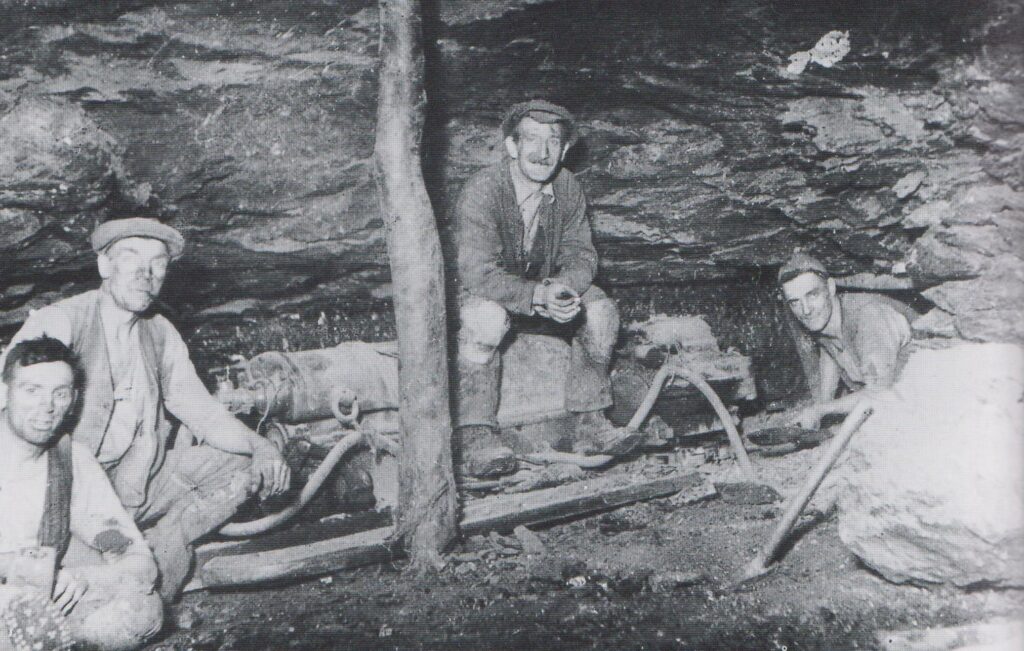
This is not new. The sub-contract or butty system of working existed in the British coal mining industry from the early nineteenth century onwards until its demise in the mid-twentieth century. In the Forest of Dean, the butty system operated in most of the deep mines from the early nineteenth century onwards until it was finally abolished at Eastern United colliery in 1938.
The butty system in the Forest of Dean up to 1888 has been discussed in detail by Chris Fisher in his book, Custom, Work and Market Capitalism, The Forest of Dean Colliers, 1788-1888, and his article “The Little Buttymen in the Forest of Dean”, International Review of Social History, 25 (1980). Fisher discusses the impact of the butty system on workforce cohesion and solidarity, and how it increased the rate of exploitation of the workforce to the benefit of employers. This account of the butty system in the mining industry in the Forest of Dean will build on Fisher’s research by extending the period up to 1938.
Chapter One examines the concept of the independent collier, the contract or butty system, the various types of contract systems employed in the British coalfield and the role of the contract teams that worked on the coal face.
Chapter Two provides a summary of Fisher’s research covering the period in the 1870s and 1880s when Timothy Mountjoy and Edward Rymer were agents for the Forest of Dean Miners’ Association (FDMA), which was the trade union representing the Forest of Dean miners.
Chapter Three outlines the role of George Rowlinson, who was the FDMA agent from 1888 to 1918.
Chapter Four discusses the butty system in the Forest of Dean coalfield in the twentieth century and provides more detail on how the system worked. The discussion will be illustrated by oral history statements in Forest dialect from a cross-section of Forest miners to reflect a range of views on the topic, which reveal common features but also highlight complexity and contradictions.
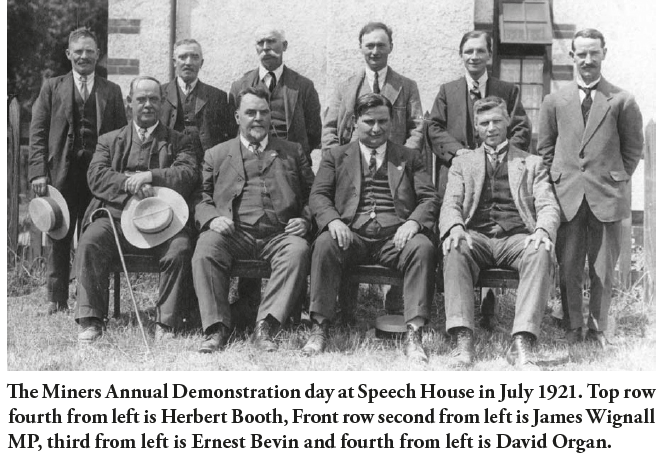
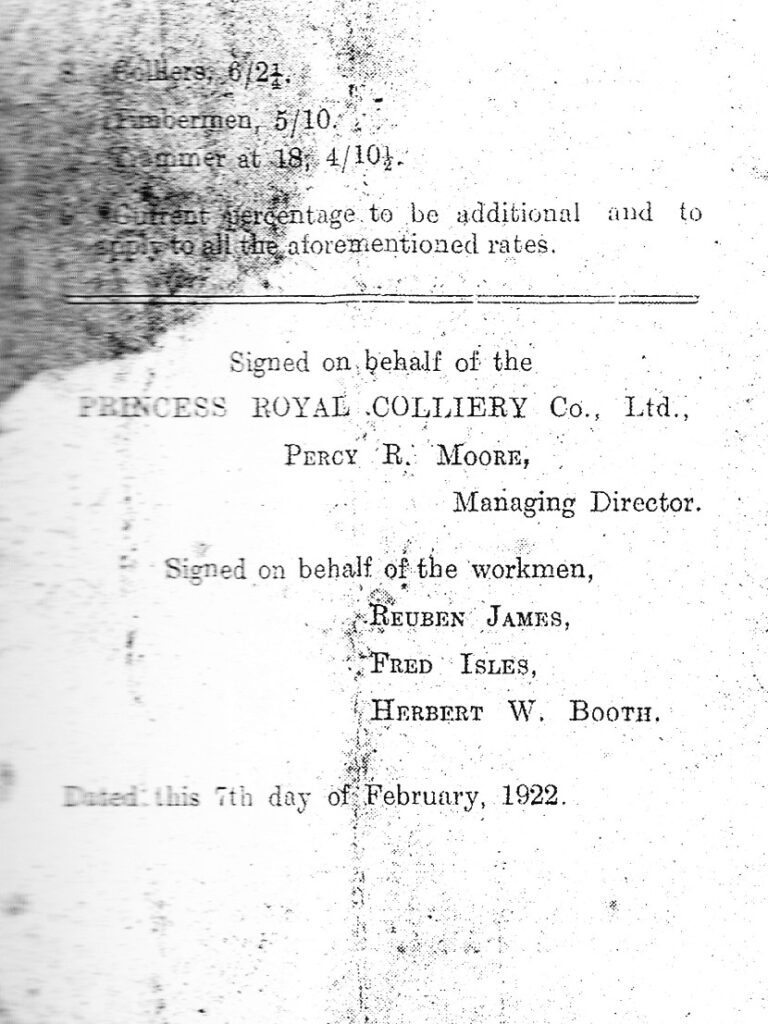
Chapter Five considers the role of Herbert Booth, who was the full-time agent for the FDMA from 1918 to 1922. Booth’s experiences in his native Nottinghamshire coalfield will be contrasted with those of the Forest.
Finally, chapter six outlines the role of John Williams, the FDMA agent from 1922 to 1953 and the events surrounding the demise of the butty system at Eastern United in 1938.
CHAPTER ONE
THE INDEPENDENT COLLIER
One of the consequences of investment by mining companies in deep mining in the nineteenth century was a significant increase in the number of miners. However, until 1978, there was a common perception among many historians that miners had become wage labourers or ‘archetypical proletarians’. By this, they meant miners had turned into a uniform class of industrial wage earners with identical interests and status who, possessing neither capital nor production means, earned their living by selling their labour with little or no control over the day-to-day conditions of work.
Adam Smith, in The Wealth of Nations, contrasts the `independent workman’ with ‘the collier’. The former is represented by the figure of the weaver or the shoemaker, who may still have a property in loom, linen or leather. The latter owns nothing but his ability to work, an ability which is seen as being perfectly indistinguishable from that of the ‘common labourer’. If the collier is more highly paid, it is not because he has any skill but is entirely due to the greater hardship, dangerous and difficult conditions and inconstancy of employment which characterise his work.[1]
Miners were perceived as living in occupationally homogeneous communities, sharing common work experiences and pursuing a common interest. As a result, miners were believed to have developed strong solidarity in their conflicts with their employers, who struggled to come up with strategies to undermine their demands for improved working conditions.
In 1978, Royden Harrison, Chris Fisher, and others from mining backgrounds challenged this view in their classic study of the nineteenth-century collier in their book The Independent Collier, The Coal Miner as an Archetypal Proletariat Reconsidered in which they explore, amongst other things, the butty or contract system of working in British coalfields in the nineteenth century and the role of miners as skilled artisans and small working masters.[2]
Hewers
In most districts in the British coal industry in the nineteenth and early twentieth there were large differentials between the various grades of workers employed in the collieries. The more experienced colliers or hewers who worked at the coal face extracting coal were highly skilled and were paid considerably more than most of the other workers in the mine. The hewers learned their trade on the job by working with the older, more experienced men.
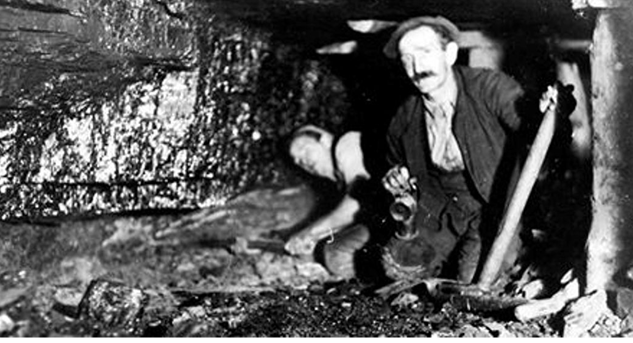
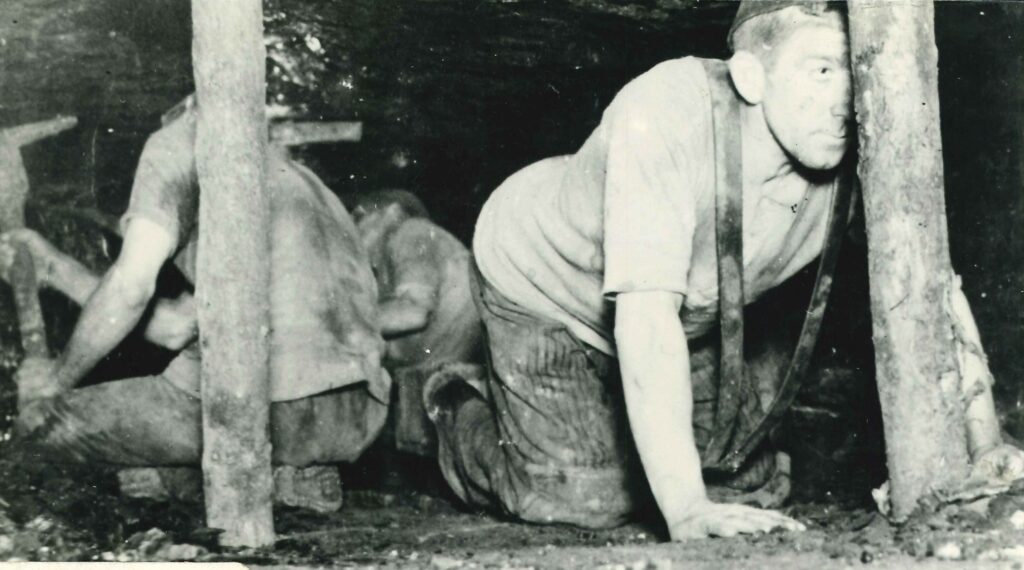
Up to the early to mid-twentieth century, hewing was done by hand using a pickaxe and other hand tools. The normal procedure for hewers was to cut a slot in the base of the coal seam so that coal would drop, or be coerced into dropping down under gravity. The roof immediately above the coal was also liable to fall and so hewers, being in the vicinity of this activity, were sometimes killed by accidental falls of coal or stone.
In the nineteenth and early twentieth centuries in the Forest of Dean, the hewing teams were led by buttymen who were paid by the ton of coal sent to the surface under a contract arranged with the colliery management. The buttyman employed men and boys who made up his team, called daymen, and he paid them a wage based on the days they worked. When demand for coal was up and prices were high and the conditions at the coal face were good, the buttymen’s earnings were usually much higher than the daymen’s.
Boys were often employed as hodders, who moved coal from the coal face to the roads, and trammers who filled the drams with coal, which were then transported to the shaft to be taken to the surface. A dram is an underground truck used for transporting coal.
The buttyman was allocated a ‘stall’ or section of the seam by the colliery manager. The stall was a rectangular area of coal to be extracted, which the buttyman regarded as his ‘place’. Sometimes this ‘place’ was shared with one or two partners or butties. The length of the seam allocated to the buttyman and the number of daymen required to work it depended on the method of extraction. This will be discussed in more detail later.
The rate the buttyman was paid for each ton of coal extracted was negotiated with the colliery owner locally by the individual buttyman, sometimes with the support of the FDMA. The rate was dependent on the conditions at the face, the width and quality of the seam, systems of working and other factors such as faulting, the condition of the roof or floor, water, etc.[3] Coal extracted by the hewing team was sent to the pit head in marked drams, where they were weighed and the tonnage recorded. The buttymen were often also responsible for timbering and opening roadways and when they were also paid piece rates for work under a contract system.[4] According to Fisher, the nineteenth-century buttyman in the Forest:
had to be something of an entrepreneur within the pit. While the principal source of his earnings was the cutting of coal to be sent out of the pit for sale, there were other jobs to be done. The pit had to be developed, that is, roads had to be driven out through the bulk of the coal so that working places might be turned away, and when the pit worked more than one seam, or where a seam had been broken or displaced by a geological fault, smaller pits or drifts had to be made within the mine. If pillars had been extracted, the space left, the goaf, had to be packed with stone or timber supports; and perhaps stone or timber left in earlier work had to be shifted so as to direct roof pressures away from roadways or working places.
As the coal industry developed and tasks were divided up, the division of labour increased. Consequently, by the 1920s, only about 40 per cent of the total workforce worked on the coal face. While men involved in timbering and creating roadways were also paid piece rates, many other tasks in the pits were carried out by men or boys employed directly by the owners. They were paid a day rate and were often referred to as the company men. These included the surface workers and labourers, the craftsmen such as banksmen, enginemen, blacksmiths, masons, carpenters, pump men, and supervisors such as deputies and overmen. [5] Also included were men and boys involved with the haulage of coal, maintenance of haulage roads, clearing roof falls, and attending to ventilation.[6] In some circumstances, such as when the contract rate for a seam had yet to be agreed, the buttymen would work for an agreed day rate. However, in most cases, the employers preferred the piece rate system because it provided an incentive without the need for micro-management.
Contract Teams
The butty system was not unique to the Forest, but there were differences between districts on how the earnings were shared out within the teams working on the contract, depending on local custom and practice. How this was organised varied considerably from district to district, and there was a spectrum of systems, some more egalitarian than others. Stephanie Tailby has identified three distinctive butty arrangements: [7]
The big butty system, whereby colliery owners sublet the working of an entire pit or districts of a pit to a contractor or partnership of contractors.
The little butty system, whereby contracting colliers undertook to work a section of the coalface or a seam at piece rates and paid and supervised a small team of men and boys.
An arrangement in which a collier or a pair of colliers working on piecework rates employed a day wage assistant, apprentice or boy.
In some districts, such as the Midlands, a single contractor or buttyman might employ many day men working a whole seam and he was viewed by the rest of the miners as very much part of the management hierarchy. This system was imported from the Midlands into the Kent coalfield in the 1920s and survived until the late 1930s.
Staffordshire Buttyman standing over his men. (Credit: www.healeyhero.co.uk/rescue/history/butty.htm)
Barry Johnson’s study of the Nottingham coalfield (Who Dips in the Tin? The Butty System in the Nottinghamshire Coalfield) and Robert Goffee’s study of the Kent coalfield (Incorporation and Conflict: A Case Study of Subcontracting in the Coal Industry) illustrate how the hierarchy and inequalities created by the butty system of working impacted on trade unionism by fragmenting the labour force and undermining solidarity.[8]
However, in some contract systems, the earnings were shared equally among all the men in the contract. Dave Douglass’s study of the Durham Pitman has revealed how a unique and more democratic form of organisation within the contract system (maras system) in the Durham coalfield created a strong sense of group solidarity and equality within small working groups.[9] The Durham miners operated a cavilling system where places were allocated afresh by drawing lots every quarter so that the more productive areas were shared equally.[10]
The puffler system in Yorkshire was similar to the little butty system, but by the 1940s, the system had changed so that the leader of the working group was paid an extra allowance by the colliery company rather than profits.[11]
It was common practice in most districts for colliers to employ boys. In South Wales, a pair of colliers might employ just one boy. It is unlikely that, even in the most equitable systems, the boys were paid as much as the men, and it is possible there were differentials depending on age and experience among the daymen.
CHAPTER TWO
THE NINETEENTH CENTURY
Coal and iron ore had been mined in the Forest of Dean for many centuries and as a result, a community of free miners had emerged who claimed certain rights and privileges. Free mining rights were claimed from ‘time immemorial’ by any son of a free miner born in the Forest of Dean who had worked a year and a day in a Forest pit. This allowed any free miner the exclusive right to open a pit anywhere in the statutory Forest of Dean, provided they paid royalties to the Crown, the owner of the land.[12]
Forest of Dean Iron Miners
The early nineteenth century saw the penetration of, and transformation of, the old free-mining coal industry by capitalists from beyond the borders of the Forest. Men like Edward Protheroe, who made his money from his slave plantations in the Caribbean, invested in deep mining in the Forest of Dean, usually in partnership with a few enterprising and ambitious free miners.
As a result, in the years between 1790 and 1830 the mining industry in the Forest of Dean had passed, in the main, from the hands of a relatively large group of working proprietors of small-scale co-operative free mines into those of a small group of men, mostly outside capitalists, who had the capital to invest in steam engines, deep mining, railroads and iron furnaces.
However, their presence was opposed by most free miners who could not compete with the new deep mines, forcing many into unemployment and poverty. This was one of the main causes of the 1831 riot when the Foresters destroyed the Crown enclosures, which had restricted their customary free mining and grazing rights.[13] It was no coincidence that during the riot, Foresters specifically targeted Protheroe’s property.[14] After the 1831 uprising, the leaders were transported or imprisoned and many were forced to rebuild the enclosures.
Mural by Tom Cousins in the Fountain Inn in Parkend
The government responded by introducing limited free mining rights, set out in the Dean Forest (Mines) Act 1838, which guaranteed that only free miners could be awarded gales.[15] However, their rights were curtailed because the condition that free mining rights could only be claimed by the son of a free miner was removed. Free miners could now sell or lease their pits to whom they liked, and the Act confirmed the right of outsiders, including wealthy capitalists, to buy, own and sell mines. While a few free miners went into partnership with the capitalists, most of the inhabitants of the Forest were now dependent on the money they earned from wages or as contractors working in the new deep pits owned by the capitalists.[16]
Fisher argues that the significance of this was that property rights were introduced to mines, which displaced the egalitarian community of free miners with their strongly held beliefs in customary rights. The ownership and the use of resources in the Forest had been fundamentally transformed in ways which favoured private property, the exchange of commodities for profit and capital accumulation for a few at the expense of the labouring many.[17]
Fisher contends that the development of the butty system in the nineteenth century in the Forest had its roots in its tradition of free mining. He argues that the butty system allowed some colliers to retain some independence as small working masters and skilled artisans, while others were reduced to wage labourers.[18]
The Emergence of the Butty System
The capitalists had little knowledge or experience of mining. Protheroe had made his money from slavery, lived in Bristol and had no practical skills.[19] However, by 1832, he held financial interests in thirty-two coal mines in the Forest and was negotiating for others.
As the new owners expanded their pits and the workings grew more extensive, there was a growing demand for skilled hewers to extract the coal. The free miners, with their expertise and deep knowledge of the Forest coalfield, were the only ones equipped to meet this need. Requiring minimal training, they provided the colliery owners with a convenient source of highly skilled labour. These free miners were soon taken on as subcontractors, or buttymen, negotiating agreements with the owners to mine coal at fixed rates per ton. The buttymen were also able to hire labour as required from within their own community. Many free miners who continued operating their small pits found it increasingly difficult to compete with the larger, more modern enterprises.
However, those working as contractors for the new colliery owners could sometimes earn more and have a regular income. Free miners had become accustomed to a degree of independence, and the butty system allowed them to continue to work with a considerable amount of autonomy, hewing coal in small teams. As a result, they could continue to work unsupervised as small working masters, employing local labourers as required. However, the men and boys they employed, some of whom were ex-free miners, were reduced to wage labourers and dependent on the buttymen for work. The old free mining community had become fractured between the buttymen and their employees
The system allowed the buttymen to define the social relations of work and exert high levels of control over the labour process, backed up by a strong commitment to custom and practice. However, it is unclear to what degree the buttymen were reproducing pre-existing social relations. The average number of miners who had been working in a free mine around 1800 was four, usually including a boy.[20] Free miners worked in partnerships, called verns, often made up of family and friends, but may have also employed one or two casual labourers, an arrangement which was often used by the buttymen.
Most buttymen worked on the job, on the face, often with fathers, sons and brothers as daymen or partners. The buttymen supplied their own tools and timber. They had to face many challenges that could lead to loss of earnings, such as opening and clearing up stalls, dealing with broken or displaced seams, coping with water and soft roofs, and the occurrence of stone. These were often referred to as ‘abnormal places’. If no coal was produced, they earned no money but still had to pay their daymen and boys. Sometimes they had to ask the colliery owners for an allowance to cover such circumstances. In addition, they could be subject to victimisation by the owners and be given difficult working conditions.
The contradiction in the butty system for the local community is clear: some Foresters could maintain some form of dignity and respect working as buttymen, but the rest became part of a casual labour force, subject to the whims of the market, the coal owners and the contractors. This is how Fisher explains the system:
Work in the large pits, from the early 1820s, came to be organised around contract miners, or buttymen. The masters employed some men on day wages, in order to maintain travelling and haulage roads in the pit, but most of those whose pay came directly from the master were contract men. A man and his mate (the butties) undertook to work a stall. That is, they agreed to hew the coal and load it into tubs, for which they received a stipulated rate per ton (the contract). The butties then employed men and boys at a fixed rate per day (the daymen) to help with the work. The butty paid his daymen rates which varied according to his assessment of their value as workmen. That depended in part on their age and experience. The daymen included experienced, adult colliers who worked at the coal face, and boys and youths in various stages of learning the craft, for the “off hand” work of loading, moving materials, cutting and setting timber, and hauling tubs from the face to the main transport roads. The number of daymen in each stall varied according to the needs of the butties, but there were not many of them: perhaps there was a ratio of two butties to four or five daymen.
Nineteenth-century buttyman and his team in a Forest of Dean mine. Credit: Dean Heritage Centre
Free mining continued, but by the mid-nineteenth century, the output of the free mines was small compared to the deep pits, although free mining remained an important part of Forest identity and culture.
In the mid-nineteenth century, about two-thirds of Forest coal went to the house coal trade throughout southwestern England, with the main demand in the winter and one-fifth went to the local iron industry. So, the buttyman’s power to hire and fire according to the demand for coal was important. This meant the daymen needed to have other jobs and often worked on farms in the summer. Therefore, their economic situation was based on both dependency and uncertainty, just like any other casual labour force. However, many of the younger daymen aspired to be a buttyman and treated their apprenticeship with the buttyman as an opportunity to learn the trade.
The owners, on the other hand, took little risk but had a guaranteed profit from the coal produced. They had no employment obligations, with no hiring and firing of labourers and did not need to micro-manage the workforce. Coal mine managers as a professional class did not exist in the nineteenth century.
Truck System
In 1870, a government commission was appointed to discover if the truck system was still operating in the British coalfields, in disregard of the Acts of Parliament prohibiting such a system. In the truck system, employers paid part or all the wages in the form of credit notes, which could then only be exchanged in the employer’s shops or pubs. During the investigation, it became clear that in some cases in the Forest of Dean, butties and mine owners were paying their men using credit notes for shops and pubs, some of which were owned by themselves or family members, and also paying their men in pubs they owned or managed.[21] In 1886, Thomas Hale, a buttyman who worked in iron mines owned by the Crawshays, wrote in his diary:
When I was a lad working in the coal pits, the butties used to take us to some public house and cause us to spend some of our money that one had worked very hard for.[22]
Fisher characterised the nineteenth-century Forest of Dean contractors as ‘little buttymen’ because he argued that they only employed a small number of men and boys.[23] However, the newspaper reports about the Commission reveal that in some pits the butties at Lightmoor, Trafalgar and Foxes Bridge were employing up to 70 men. This meant that in some cases in the 1870s in the Forest of Dean, the buttymen were in control of whole seams or sections of the mine as they were in Nottingham and Derbyshire. In terms of social relations, there was a significant difference between these contractors and the little buttymen who may only employ one or two labourers. The term butty system must, therefore, be used with considerable caution as its meaning varied from district to district, pit to pit and seam to seam and changed over time.
Examples of the Ratio of Large Buttymen to Daymen in 1870[24]
Buttyman
Colliery
No of Daymen
Proprieter
James Braidnack
Foxes Bridge
40
Shop
John Hamlyn
Lightmoor
70
Shop and Pub
John Emery
Lightmoor
70
Shop and Pub
William Bevan
Lightmoor
10
Pub
James Griffiths
Duck Pit
10
George Herbert
Trafalgar
40
Examples of Ratio of Little Buttymen to Daymen in 1874[25]
Buttyman
No. of Daymen
William Meek
3 including 2 Meeks
Thomas Phillips
2
Elijah Matthews
2-4 plus 2 boys
Joseph Baldwin
2 plus 2 boys
Samuel Saysell and Jude Williams
5 plus 1 boy
Shellah Russell and Joseph Burrris
4
Trade unionism
The butty system created divisions within the workforce, which impacted the development of trade unionism and its relationship with the colliery owners. The divisions were not only between the buttymen and their daymen but also between the buttymen themselves as they competed for the best workplaces or stalls. This could lead to victimisation or favouritism because some stalls were more difficult to work than others due to water, faults, soft roofs, etc. At the same time, the buttymen were aware that an experienced day man could always step in to take their place during a dispute with the owners. Since the butty system undermined union organisation, it was opposed by the Miners’ National Union (MNU) led by Alexander Macdonald. In November 1866, the Gloucester Journal reported that:
At Wednesday’s meeting of the Miners Conference now sitting in Nottingham, the butty system came under review and was universally condemned. One of the speakers characterised it as the worst evil under which the miner suffered, and another as the root of most of the miners’ grievances. The views of the Conference on the subject are to be embodied in their petition to parliament..[26]
William Morgan, a butty, raised the question of divisions among the men at a meeting in Cinderford Town Hall in October 1871. He complained of how the masters might set the men against one another and argued that there is no other way open to us than to have a union and stick together.[27]
Timothy Mountjoy (July 1871-1878)
There were no recognised miners’ trade unions in the Forest of Dean before 1871. Before this, the buttymen negotiated their contract rates either individually or collectively at each pit. A typical rate paid to the buttymen in 1870 was 1s 6d a ton, with a pit head price for the colliery owners of 10s a ton. The rate varied from pit to pit, seam to seam. However, there was competition between the buttymen and this could lead to undercutting. There were also many disputes about how the coal was weighed at the pit head and this led to to a breakdown in trust between the owners and the buttymen.
At this time, most agreements between the buttymen and the colliery owners were based on an informal sliding scale in which a percentage was added or deducted from contract rates as the price of coal went up and down. The sliding scale assumed that there was an identity of interest between capital and labour and wages were subject to the anarchy of the coal market.
An example of an informal agreement could be as follows: If the pit head price of coal is 10s a ton and the negotiated contract rate between butty and master was 1s 6d a ton, then an increase in the price of coal of 1s could give a 5% increase in the contract rate, giving a new contract rate of 1s 7d per ton. These agreements were often ad hoc and varied from pit to pit and contract to contract. However, the colliery owners often did not abide by agreements and rarely voluntarily increased wages.
In the early 1870s, the rising price of coal led to a strong demand for labour, which empowered the miners to try and push up the contract rates. The owners refused their demands and so in July 1871, a strike of 800 men and boys at Trafalgar colliery, followed two months later by a strike of 600 men at the Parkend Coal Company, resulted in increased wages.[28]
The strikes were led by buttymen but involved the whole workforce. Six trade union lodges were formed, representing the main large pits and the men organised themselves into the Forest of Dean Miners’ Association (FDMA).[29] They elected a council made up of representatives from each lodge.[30] They then recruited a popular local miner and preacher, Timothy Mountjoy, as their full-time paid worker.[31] The FDMA then affiliated with the national miners’ union, the Amalgamated Association of Miners (AAM), which had the resources to pay strike pay.[32] There is no evidence that the larger buttymen mentioned above were elected to the council, as they would have been viewed as very much part of the colliery management.
Timothy Mountjoy
The price of coal continued to rise, reaching 20s for the best Forest block coal by the summer of 1873. As a result, the FDMA successfully pushed contract rates up by 40 per cent above those of 1871.[33]
The buttymen also gained the right to appoint their own checkweighmen, which was sanctioned by the Mines Act of 1872, to verify the findings of the colliery owner’s weighman on the tonnage of coal produced by each hewing team. The checkweighman needed to have good literacy and numeracy skills and often became the lodge representative in negotiations with the owners. The FDMA insisted that calibrated weighing machines be installed at the pit banks. Fisher argues that in the nineteenth century:
Elected by the butties and paid by them, the checkweighman was perhaps the only person in the pit who was capable of maintaining independent action, of surviving moments of vindictiveness on the part of the master. The checkweighman, therefore, became the focus of lodge organisation, keeping the books, calling and chairing meetings and leading deputations..
The FDMA also obtained an agreement to reduce winding hours from ten to eight and that wages be paid every two weeks.[34] By 1873, the FDMA had recruited 4,500 members, or about eighty per cent of the total number of colliers in the district. including the buttymen, day men and company men.
However, there was still no guaranteed rate for the day men whose pay remained dependent on their level of skill, age, value in the labour market and whim of the buttyman. There was also no guaranteed work, as some daymen may only be offered one or two days of work a week, while others could get 5 or 6 days a week. The FDMA Council initially accepted that it was up to the buttyman to determine when and where the day men could work and what wage he paid his men. Sometimes percentage increases were not passed on and daymen could easily be victimised or sacked.[35]
The approximate market wage for a skilled day man in September 1873 was based on the rate for 1871, which was 3s 4d per shift. However, in most pits, the buttymen were very aware that they had to keep daymen on their side and so, in most cases, increased wages if there was an increase in contract rates. This meant that, by the summer of 1873, most of the skilled daymen were now earning the 1870 day rate (approximately 3s 4d) plus 40%, giving 4s 8d, but their labourers and boys earned less.[36] In contrast, the company men, such as banksmen and surface men, were paid approximately 2s 8d plus forty per cent.
Despite this, there was conflict when it became apparent that some of the buttymen at Trafalgar did not pass on the advance to their day men. In response, the FDMA passed a resolution that all advances should be passed on to the day men. The FDMA Executive Council went further and suggested 6s plus 40 per cent for skilled daymen. This led to a flurry of letters in the Forest of Dean Examiner.
Some miners argued that some of the day men were every bit as skilled as the buttymen and so should be awarded a good rate if they worked hard. Others argued that some daymen were “clod hoppers recently come from the plough tail” and “the public house slashers” and should not be paid the same as those with skills. One day rate collier argued:
I am one of those who believe the time has come when the ordinary collier should speak plainly out, objecting to the present unsatisfactory method of paying the daymen. I venture to say that every day collier able to do a fair eight hours’ work ought to have the same uniform standard wages, together with his 40 per cent. Having in general terms explained the grievance of our day-men or at least many of them—l would affirm that in the Rocky vein, where I am a day collier, there are some butties who out of every five per cent, pay their men at a reduced rate, instead of what is fair, just, and honourable.
Some skilled day men accepted that the experienced buttymen should earn more, while others insisted on higher pay. The demand for skilled daymen was high and so some could negotiate higher rates of pay. Some others were able to negotiate with the owners for their own stalls and became buttymen themselves. In the end, the FDMA decided to leave it to the buttymen to choose how much they wanted to pay their daymen according to their market value.
Average Earnings per shift for Little Buttymen in September 1873 (2s a ton for cutting coal)[37]
Buttyman
Earnings per shift
James Johnson
10s 8d
Davis
9s 3d
Edwards
13s 2d
John Tingle
12s 1d
Charles Smith
7s 8d
However, the buttymen sometimes earned little for themselves or even made a loss. For instance, in December 1874, it was reported in the Forest of Dean Examiner that Samuel Saysell and Jude Williams had no money left over after paying their 5 daymen 5s 6d a shift and their one boy 2s 4d a shift.
Lock Out
In 1873, the colliery owners responded to the formation of the FDMA and formed the Forest of Dean Coal Mine Owners Association. However, in the summer of 1874, the price of coal fell and the owners announced they would cut the rates by 10%. In the autumn, the owners attempted to impose another 10% reduction, but the FDMA refused to accept the wage cut and challenged the owners’ figures on the selling price of coal and the amount wages had increased during the boom. The owners refused to negotiate with the FDMA, characterising Mountjoy and district officers as inflammatory agitators. The miners refused to work for the new rates and so were locked out of their pits
After 10 weeks, the owners struck a deal with the AAM national officers, who were concerned about the mounting cost of the strike, while Mountjoy and his fellow officers were locked out of the talks. The agreement accepted the 10% reduction and the men reluctantly returned to work in February 1875 after struggling to survive through one of the coldest winters for a generation. The owners imposed another two cuts in tonnage rates in July 1874. In response, the buttymen cut the rates paid to the day men and laid some off.
The owners continued to refuse to meet with Mountjoy and district officers and insisted that they would only negotiate directly with representatives of the buttymen from each pit. As a result, the power of the FDMA ebbed and the role of the individual lodges became more important.
Sliding Scale
In August 1875, a formal sliding scale to govern the movement of hewing rates of pay in relation to coal prices was agreed between buttymen and the colliery owners at a meeting at Littledean. A percentage was added or deducted from this figure depending on the selling price of the coal. The agreement was based on a price of twelve shillings per ton at the pit mouth for the best-screened block. The buttymen’s tonnage rates were agreed at 15% over the base rates of 1871. From that base, rates were to move five per cent for every movement of one shilling in prices. There was no provision for the day men, who were left by default to the kindness or not of the buttymen.
Since the colliery owners continued to refuse to meet with Mountjoy and the FDMA officials and wages were determined by the sliding scale, there was no role for the FDMA. Any negotiations were carried out by deputations made up of the buttymen or checkweighmen from the individual pits.
In February 1877, the owners imposed another ten per cent reduction, and 3000 miners refused to work. In one case, desperate strikers fired a gun at enginemen at Trafalgar colliery who had returned to work during the strike to operate the pumps to prevent the mine flooding.[40] In another case, John Harris from Harry Hill, who had returned to work, had his house blown up with dynamite, and soon after, John Trigg from Bream, who had returned to work at New Fancy colliery, was badly beaten up.[41] The owners still refused to meet with Mountjoy and members of the FDMA Council. Consequently, a deputation made up of delegates from each pit was forced by the owners to accept the ten per cent reduction.[42]
During 1877 and 1878, the price of coal and wages continued to fall partly because of price competition amongst the owners.[38] This situation hit the day men particularly hard as many were forced into short-term work or unemployment. Some unemployed day men were granted poor law relief, provided they accepted unpaid work breaking stones in local quarries.[39]
Soon, the level of wages was reduced to that of 1871, the membership of the FDMA had collapsed and there was no money to continue to pay Mountjoy. The owners became law unto themselves and no longer abided by the Littledean agreement.[43] For example, in September 1879, the owners of New Fancy Colliery imposed another ten per cent reduction on the rate per ton. With no district organisation, the buttymen reluctantly accepted the reduction and imposed a ten per cent cut in the wages on the day men, which gave them just 3s a day. The day men refused to accept this and went on strike, but with no district union, they were forced to accept the reduction and returned to work, defeated, one week later.
Neddy Rymer (1882 -1886)
In 1882, confidence among the workforce returned as the price of coal began to rise. A group of miners, led by the checkweighman John Ennis, decided to rebuild the FDMA and recruited a new agent, Neddy Rymer.
Rymer had been involved in mining union activism since the 1860s and worked in most of the coalfields in northern England, where he had gained a reputation as a militant arguing against the sliding scale and alternatively arguing for a living wage which was independent of the price of coal.[45] In 1873, he said:
Whatever be the price of coal or iron, or whatever be the state of trade in the money market, we must have our position made secure and our labour protected from the wolves and vultures of a mean, selfish, and brutal generation.[46]
This meant that in 1873, he was against the use of a sliding scale. However, by the late 1870s, he had moderated his views after the depression in the coal trade led to defeats in coalfields across the country. Consequently, when he was recruited as the new FDMA agent in 1882, he argued that his first task would be to negotiate a sliding scale and a board of conciliation with the owners.
A meeting in Cinderford on Saturday 14 October 1882, attended by Rymer, Mountjoy and national officers, formally announced the formation of the new organisation and agreed to demand a ten per cent pay rise.[47] By the end of the month, the FDMA had accepted a 5 per cent offer from the employers on condition that they agreed to the establishment of a sliding scale.[48]
In his first two months in the Forest, Rymer was successful in building up the FDMA with 1000 members, including buttymen, daymen and company men. Soon, about 30 pit lodges had been formed and sent delegates to the new FDMA Council, which affiliated with the AAM. At the end of November, the FDMA presented four demands to the owners:
Another increase in wages of 5 per cent.
Buttymen should receive a tonnage remuneration for work in abnormal places.
The formation of a sliding scale based on company accounts and a board of conciliation.[49]
However, initially, the owners would only accept the demand for a conciliation board.[50] In addition, the FDMA Council, now representing the daymen as well as the buttymen, demanded:
The election of checkweighmen by all the workmen, including the daymen.
Day men should not be paid in pubs, particularly if they were owned by a buttyman.
All these demands were controversial. The checkweighmen had traditionally been voted into office by the buttymen to whom they felt responsible, rather than by all the colliers of whatever status.
The issue of weekly pay was contentious because it would mean that the owners and the buttymen would need to agree on details of work done every week, including measuring up the yardage for timbering and road ripping, as well as the total tonnage of coal mined.
The buttymen often expected the trammers, who were employed by the buttymen, to clear coal from the face to the pit head and get it weighed in after they had left work in preparation for the next day’s work. This meant they were expected to work more than eight hours. In fact, there were cases of the buttymen employing children unsupervised on the night shift to move coal mined during the day. At a meeting in September 1973, Mountjoy reported that:
at Crump Meadow there were two butty men who holed theft coal in the day and prepared it, and at night sent their two lads to hod it into the roads, and another to fill it. There were these little boys away down in the pits, perhaps 150 yards from any living creature.[52]
The day men had traditionally been paid in pubs, some of which were owned by buttymen or their relations.
As a result, the FDMA Executive immediately ran into conflict with some of the more powerful Lightmoor and Trafalgar butties and their checkweighmen over these four demands. Things came to a head at a meeting in Cinderford on Saturday 2 December 1882, when an argument erupted and two checkweighmen from Lightmoor were ejected from the meeting.[53] Consequently, the two checkweighmen involved, William George and John MacAvoy, wrote a letter to the FDMA Council.
Credit: Dean Heritage Centre
Cinderford, December 11th 1882.
Mr Rymer, Sir, – we, as Butty Colliers of Lightmoor, beg to inform you that we are opposed to the one week’s pay, as we can do very well as it is now, and don’t want any alteration. And we consider that you quite insulted us by ordering our Checkweighmen from the Town Hall, on Saturday, We hope that you will shut your mouth about Lightmoor for the future, as we can do very well without your help. We hope you will never set your foot on Lightmoor Works again, and the sooner you get back to where you came from the better. We don’t want any bandy-legged grabbers here. We can do very well with our masters, without your help.
(Signed WILLIAM GEORGE and J McAvoy ) per Buttymen.
The next day, the FDMA Executive Committee met and drafted the following reply, which was circulated to all those concerned.
Credit: Dean Heritage Centre
That this Executive, Committee, of the Forest of Dean Miners’ Association, absolutely and emphatically and solemnly condemn the base and cowardly action of Messrs. MacAvoy and George, and the few Butty Men from Lightmoor, for sending such a cruel and inhuman letter to Mr Rymer, our Agent, and that this Committee authorise the Agent to answer the letter, and send it through the District and through the Press in Circulars, and that a Deputation of the Committee go to Lightmoor Colliery and investigate the whole matter, and call on the Lightmoor men to instantly discharge the two Checkweighmen for their base and cowardly conduct.
As Mr. Rymer was made a cripple through illness and misfortune, and to insult him for his misfortune, is to insult and degrade every miner in England, which the Forest Miners, and their wives and families, will never sanction. Shame itself ought now do its own work on the authors of this letter.
Committee Room, Cinderford, December 12th 1882.
However, by now, the membership had reached about 3,000, three-quarters of the miners in the Forest of Dean.[54] Rymer had built up a hardcore of loyal supporters among the day men and some of the smaller buttymen, including the chair of the FDMA Council checkweighman, John Ennis. At a meeting between the owners and the FDMA representatives on Monday 18 December, the owners conceded a 5 per cent rise in contract rates. Rymer also attended a national conference in Leeds with a mandate from the FDMA to support a motion for the regulation of the output of coal by working only eight hours a day.[55]
Living Wage
By March 1883, a depression had returned to the coal trade, and as a result, the colliery owners proposed a 10 per cent reduction in wages. Rymer argued that the men should be paid a living wage independent of the price of coal, which meant a rejection of the sliding scale. He argued that it is not the miners’ responsibility that competition between owners forces down wages. He added that the FDMA should reject arbitration based on coal prices but accept arbitration on the establishment of a minimum wage, which would force the price of coal upwards.
Consequently, the men refused to accept the reduction and so were locked out. As with Mountjoy, the colliery owners refused to talk to Rymer and the FDMA District Officers. This attempt by the owners to undermine the union again caused considerable bitterness and conflict within the local community. On one hand, some of the larger buttymen from Lightmoor and Trafalgar Colliery returned to work on the owners’ terms and attacked Rymer in the local press. On the other hand, some of the smaller buttymen and daymen stayed out on strike. Some were driven to acts of violence. such as the dynamiting of the house of William Wilce, who was a checkweighman at Trafalgar Colliery. In addition, the house of John Smart, who had returned to work at Trafalgar, had its window broken.[56]
The following words were posted on the walls outside Lightmoor Colliery:
Blood! Blood! Blood! If you go into work you had better make your wills.[57]
However, after five weeks and the intervention of national officers, the men returned to work with a 5 per cent reduction, with the other 5 per cent referred to arbitration. In the end, they agreed on a total of a 7.5% reduction. Rymer felt betrayed by the national union and maintained his position that miners should be paid a living wage, whatever the price of coal:
The miner seeks….. to claim from the country a fair reward for his labours and, as the country employs her wealth, and possesses her power and influence through the manhood, skill and labour of the workman, he sees no reason why he ought to toil and live in poverty……This the miner sees, and determines not to allow his blood and life to be bartered away like dead metal, or as though he were a mere chattel. [58]
However, as before, the power of the FDMA was undermined by the tactics of the owners, the sliding scale and the existence of the butty system, which created divisions in the workforce. Rymer struggled on to keep the FDMA alive and was forced to accept a sliding-scale agreement to run to 1884. The scale was based on a pithead selling price of 9s a ton, with the buttymen receiving 2.5% above the 1871 contract rate. This was accepted by the buttymen but ignored the plight of day men who were left again with no agreement on wages.
Rymer continued to campaign for weekly pay and the end to the payment of the men in pubs, but without success. However, he successfully campaigned for timber to be provided by the owners, obtained an agreement that the existing custom of 21 cwt in a ton of coal be reduced to 20 cwt in a ton and was instrumental in getting a Liberal MP elected in the constituency.
However, after the strike, he lost his authority because the colliery owners refused to negotiate with him while the senior buttymen accepted the establishment of a sliding scale. The re-signing of the agreement in 1885 and 1886 effectively made the district union and the agent redundant. By June 1886, there were not sufficient funds in the union to pay his wages and he was asked to resign. Fisher argues:
Our understanding of colliers’ unionism, at least in the Forest of Dean, is modified if conventional assumptions about the traditional social cohesion of the colliers are abandoned and the divisions of the labour process are taken into account. The union is seen not to have been concerned in an even-handed way with the problems of all colliery workers. It was the buttymen who started the union in the first place. Their view of pit work governed the behaviour of the union, particularly in the key area of wage bargaining. The butty wanted a fair share of the fluctuating price of coal, but had no ambition to set a minimum rate or standard for his labour: as a small working master he accepted the fact of risk and its influence on his profits. Given a formal sliding scale which would distribute the price of coal equitably between master and butty, there was no reason for them to quarrel. The dayman was, in the union as in the working place, subordinate to the butty. The union made no attempt to abolish the dayman’s condition of dependency. For their part, the masters chose to deal with the buttymen through the nexus of the sliding scale.[59]
CHAPTER THREE
GEORGE ROWLINSON
In 1886, while travelling the country promoting a Liberal newspaper, TheLabour Tribune, George Rowlinson visited the Forest of Dean and addressed at least ten meetings in the district promoting the paper and trade unionism. On the night before he was due to leave, he was approached by a group of checkweighmen led by John McAvoy and William George, who asked him if he would be willing to take on the role of agent of the FDMA. He accepted and for the next 32 years, Rowlinson worked closely with the checkweighmen and buttymen who dominated the FDMA Executive during his years in office.
Rowlinson was a man of moderate views and an advocate of the sliding scale and a cautious, market-conscious approach to dealings with the colliery owners. The senior buttymen and checkweighman had found someone who suited their needs. Fisher contrasts Rymer with Rowlinson in this way:
His first meeting was not for the purpose of denouncing the masters as tyrants and robbers of value which labour had created or to demand a wage increase. It was a tea meeting presided over by the Reverend W. Thomas, at which Rowlinson expounded his belief that the interests of masters and men were identical.[60]
Miners’ Federation of Great Britain
However, Rowlinson’s approach to industrial relations was at odds with developing militancy in the nation’s coalfield, which sought to break down regional isolation and led to the formation of the Miners’ Federation of Great Britain (MFGB).
The MFGB was established in 1888 to represent and coordinate the affairs of local and regional miners’ unions in England, Scotland and Wales while allowing the district associations, like the FDMA, to remain largely autonomous.
At the inaugural meeting, it was agreed to raise funds to campaign around wages and conditions and for an eight-hour day, secure legislation, and obtain compensation for miners killed in accidents. The MFGB was hostile to the sliding scale as it had failed to provide a living wage during the depressions in the coal trade.
The founding unions which formed the MFGB covered Yorkshire, Derbyshire, Nottinghamshire, Lancashire, Cheshire, North Wales and the Midland Counties, including the Forest of Dean, Bristol and Somerset. However, the exporting districts of South Wales, Northumberland and Durham initially refused to join and their leaders were strong advocates of the sliding scale. The MFGB’s membership increased by 30% in its first year, and by 1890, its member federations had 250,000 members.
1893 Strike
Just like in the early 1870s and 1880s, the MFGB and FDMA achieved some success on the back of a rising market in the coal trade in the early 1890s. However, when the price of coal fell in 1893 because of a depression in the coal trade, the coal mine owners threatened to reduce wages by 25%.
The miners in those areas that had joined the MFGB, including the Forest, refused to accept the reduction in wages, and at the end of July, miners in most pits in districts affiliated with the MFGB were locked out.[61] The fundamental issue behind the lockout was the use of the sliding scale, which had forced miners’ wages below the poverty level.
John MacAvoy, who was chairman of the FDMA, disagreed with the strike and resigned at the end of August. Then on 18 September, despite some local and national opposition, Rowlinson, with the support of some of the buttymen in the Forest, led the Forest miners back to work. Rowlinson negotiated a deal with the employers, resulting in a 20 per cent drop in wages and a return to a sliding scale agreement. However, the shortage of coal because of the strike led to a temporary increase in the price of coal, and so contract rates in the Forest rose. Rowlinson argued that his decision had been vindicated. However, the unilateral action resulted in the expulsion of the FDMA from the MFGB.
In the other regions, the strike continued and, after the use of troops to shoot dead striking miners in Yorkshire, the government intervened and encouraged the owners to agree upon a return to work with no cut in wages and no cuts to take place before 1 February 1894. In addition, it was agreed that wages in future would be determined by local Conciliation Boards, which would avoid drastic cuts in wages. This meant the formal sliding scale, which tied wages directly to the price of coal at the pit head, was abandoned. The miners returned to work on 17 November without having to concede any loss in pay. In the end, a 10% reduction in wages was agreed by the conciliation boards to start from July 1894.
The Conciliation Boards
The local Conciliation Boards were made up of an independent chairman, worker and owner representatives. Their main purpose was to resolve industrial disputes without resorting to lockouts, strikes and violence. In doing so, the Conciliation Boards were able to take other factors into account, such as inflation, cost of living, and capital investment and they attempted to avoid any severe reduction in wages.
The FDMA was able to take advantage of this agreement, and in February 1895, the FDMA reached an arrangement with the local coal mine owners to set up a local Conciliation Board. However, in the Forest, the FDMA continued to use a sliding scale, which was overseen by the Conciliation Board, which agreed a percentage increase or decrease in wages of 5 per cent in line with a one-shilling increase or decrease in the price of coal.
In the Forest, a base rate was set at the rate agreed in 1888 and applied to tonnage rates, rates for other tasks such as road ripping and timber work. Similarly, for those on a day wage and employed by the buttymen or the company, the base rate was the actual level of pay in 1888. However, since the base rate was set at different levels for different areas, pits and coal seams, the rates varied considerably depending on the conditions and local negotiations. In addition, new base rates would need to be negotiated between the miners and the mine owner for new seams or changes in conditions. The percentage above the base rate was agreed upon by the Conciliation Board and reviewed at regular intervals, depending mainly on the price of coal.[62]
In addition, in 1895, it was agreed that the maximum percentage above or below the base rate would be 60 per cent. In 1888, in the Forest of Dean, the day rate for hewers was 4s a shift. In 1898, the minimum day rate for hewers was 4s plus 15 per cent, giving a minimum wage of 4s 7d a shift. The buttymen, who were on piece rates, normally earned more than this and may have paid their skilled daymen a day rate above or below this wage. It was accepted practice that the buttymen would pay skilled daymen this rate, but there was no statutory obligation to do so.
Gradually, the other local associations joined the MFGB. In 1908, the Liberal government passed the Coal Mines Regulation Act, which limited the hours a miner could work to eight hours per day, which was one of the demands raised by Rymer in 1883.
In September 1909, a ballot of the FDMA members resulted in 93 per cent voting in favour of re-joining the MFGB. By then, John MacAvoy had obtained work as manager at Lightmoor Colliery and established a close relationship with the buttymen at the pit.
In October 1909, six buttymen came out in a dispute over the cutting of a pillar of coal at Flour Mill colliery. When the owners sacked the buttymen, the rest of the 700 men also came out on strike in support. As a result, the owners threatened to close the pit. However, the men returned to work after two weeks when concessions were made on both sides.
1912 National Miners’ Strike
The conflict over payment for working in abnormal places was one of the main factors leading to the 1912 National Miners’ Strike. In October 1911, an MFGB conference resolved:
to take immediate steps to secure an individual district minimum wage for all men and boys working in the mines . . . without any references to the places being abnormal.[63]
Individual districts prepared schedules of minimum rates for each of the various grades of labour. For instance, Nottinghamshire and Yorkshire asked for a top rate of 8s for hewers. In the end, the MFGB officially conceded to a demand of national rate of 7s. 6d. In a national ballot, over half the MFGB membership voted for strike action in support of their demand. In February 1912, after negotiations failed, a nationwide strike over the demand for a national minimum wage began. The strike involved one million workers and had the support of Forest of Dean miners who had voted 1,585 for the strike with 245 against. It was the biggest strike Britain had ever seen and for more than a month, the nation’s pits were closed.
The strike was solid in the Forest, including both union and non-union men, buttymen, and company men. FDMA members, who received strike pay, voted at a meeting in Speech House to provide relief to non-union men from their General Accident fund.[64] It was the biggest strike Britain had ever seen and for more than a month, the nation’s pits were closed.
However, the result was only a partial victory for the miners after government intervention established the principle of a locally negotiated minimum wage under the new Coal Mines (Minimum Wage) Act 1912. The government argued that the difficulty of issues such as the diversity of conditions and classes of work, especially for day men, could only be overcome by a decision that the individual minimum wage would be arranged by the district itself and be as near as possible to the present wages. In fact, nationally, the majority of miners rejected the settlement, arguing for a nationally agreed minimum wage, but the MFGB Executive overruled this at a special conference.[65] The local minimum wage was to be decided by district boards under an independent Chairman. In the Forest of Dean, the Chairman was the local aristocrat and Tory, Russell Kerr.
As a result, men working in abnormal places were now at least guaranteed a minimum wage. This included the buttymen, who were also required to pay their men a minimum wage. This was the very demand made by Rymer in the 1880s and had taken thirty years of campaigning to achieve it.
In the Forest of Dean, the rates were negotiated based on the base rate of 1888 plus the existing percentage. In 1912, this was 4s plus 30 per cent, giving a day rate for hewers and buttymen of 5s 2d. This was at least 2s below the larger coalfields where the price of coal and productivity, because of better conditions, was higher.
The agreement for most districts included a stipulation that no adult over 22 and under 65 should receive less than 5s per shift and no boy less than 2s. This was roughly the average pre-war working wage. However, in the Forest pits, Rowlinson agreed to an exemption from this stipulation. He gave in to pressure from the colliery owners and argued that it could lead to men and boys being thrown out of work as higher wages could threaten the viability of the Forest pits. As a result, the day men would receive less depending on age and experience on a scale down to 1s 3d for the boys. Consequently, the pay of some of the men was below the recently set national minimum rate. For example, the skilled timbermen were to receive a minimum of 4s a shift. This arrangement was primarily suited to the buttymen because it reduced the wages they had to pay their daymen.
However, the introduction of the Minimum Wage Act transformed the nature of the butty system in the Forest of Dean. The Act meant that the daymen were guaranteed a minimum wage in law and were no longer subject to the whims of the buttymen in terms of their earnings. Secondly, the buttymen themselves were guaranteed a minimum wage. If their earnings were not high enough to pay the day men the statutory amount, then the company was required by law to make up the difference and provide a minimum rate for the buttyman himself.
CHAPTER FOUR
TWENTIETH CENTURY
Also, by the twentieth century, there were no records of buttymen employing the large number of workers mentioned earlier. lan Marfell, who worked at Trafalgar Colliery in the early 1920s, probably sums up a typical arrangement:
Will Reed and Frank Arkell were the two buttymen and had several other men working for them, who were paid a daily wage. Any money earned over and above that was shared by the two buttymen. This system was used in all the house-coal collieries at the time.[66]
By the 1920s, most teams in the Forest of Dean consisted of a butty or a pair of butties with one or two day men and a boy, although some teams were larger and the system varied from pit to pit. In 1929, at Eastern United, the teams varied from about four men up to about nine men.[67]
In the early 1920s, coal in the Forest of Dean was still extracted by hand and in most cases, the buttymen were directly involved with hewing coal themselves. The buttyman and his team performed the complete operation of coal extraction, which included the undercutting of the seams, digging out the coal and filling the drams. They could also be involved in timbering and driving new roadways to transport coal and access the coal faces, often using explosives, all paid on piece rates. The degree of job control enjoyed by the buttyman was still almost complete. The buttyman was autonomous in the organisation of his work tasks and responsible for all aspects of coal extraction with little external supervision. This was highly skilled work and based almost exclusively on knowledge gained through extensive experience in coal extraction in a range of geological conditions. Albert Meek explained:
Then you got rock road to drive and one thing and another; timbering – we were complete colliers we used to do the shot firing. They’ve got shot firing separate these days. We used to do all the timbering and we used to do everything that you could call a collier. You had to be complete colliers at that time.[68]
Since the buttyman was almost in complete control of the labour process and his remuneration was dependent on the amount of coal sent to the surface, he had the power and incentive to make sure his team was fully employed and worked hard throughout the shift, which sometimes could lead to bullying and exploitation.
Since the buttymen were paid on piece rates and acted as supervisors, there was still no need for micro-management of the teams working deep in the mine. In addition, the buttymen employed their day men, so the colliery owners had no employment obligations such as supervision and the hiring and firing of labourers. At the same time, the colliery owners received their profits while relegating responsibility for organising the hewing process and the disciplining of the workers to the buttymen.
Bert Bowdler and his assistant undercutting a twenty-inch seam of coal by hand at Lightmoor colliery (Credit: Photo by A B Clifford held by Dean Heritage Centre)
However, there was now some oversight by underground officials directly employed by the colliery company. The deputies were charged with the supervision of safety, the ventilation of the workings, the inspection of timber work, etc. The deputies were responsible to the overman who was in charge of all the workings and was directly responsible to management. In addition, the daymen were listed on the company books so colliery owners could be held responsible in the case of accidents and the colliery owners were obliged to pay compensation in the cases of death or injury. This could mean there was no deterrent for the buttymen to take risks.
Price Lists
In most pits, an agreement between the FDMA and colliery owners included a detailed price list that listed the tonnage rates for coal produced and a piecework rate for a whole range of other jobs such as road ripping (paid by the yard), installing and repairing timberwork and associated work such as clearing dirt, which was not directly productive.[69]
The price lists were regularly reviewed by the colliery management, usually by negotiation with the FDMA and the buttymen. These negotiations took place all the time and often on the spot. If the issue was not resolved, the team could down tools, leading to a strike involving the whole pit. This was the case in 1909 when six buttymen came out in a dispute over the cutting of a pillar of coal at Flour Mill colliery. When the owners sacked the buttymen, the rest of the 700 men also came out on strike in support. As a result, the owners threatened to close the pit. However, the men returned to work after two weeks when concessions were made on both sides.[70]
At the time of the 1926 Lock Out, a Cinderford miner explained in a letter to the Gloucester Citizen how the butty system operated:
According to the agreement, every collier knows that there is what is known as a basic rate for cutting coal, timbering, etc. This varies according to the seam of coal worked, for instance: the ” Starkey ” vein of coal, which is from 12 inches to 14 inches thick, has the highest price per ton, namely 3s. 9d., plus a percentage, which in any case would not be more than 7s 6d at the rate paid before the stoppage.
The basic rate paid for making a road 10 feet wide by 7 feet high is 10s. per yard, plus of course 80 per cent according to the new terms in this seam. The roof to be taken down would be 5ft. 6in in thickness and 9ft. in width, and if any timber were required the price per pair would be 1s. 9d. plus, of course, percentage, and 2s. 6d. for partong caps, that is timber where two roads are separating.[71]
Trade Unionism
Most Forest buttymen identified with the principles of trade unionism and often were active members of the FDMA who supported them in their conflicts and negotiations with the colliery owners. The FDMA was involved in most negotiations to prevent buttymen from competing for contracts or undermining each other by offering low contract rates. In fact, even up to the 1920s, the FDMA was effectively a buttyman’s union and most disputes were driven purely by buttymen’s concerns, such as price list and tonnage rates, the condition of the seams, water in the pit, the extra allowances for dead work, conflict over dirt in the coal and so forth.[72] In the early 1920s, the majority of the FDMA Executive Committee were still buttymen or checkweighmen.
One example was Jesse Hodges (1880 – 1964), who was born in Nailbridge, near Cinderford. He started to work in an iron mine as a boy and then moved to Crump Meadow colliery where he worked his way up to be a buttyman, employing his son, Jesse Hodges (Jnr), as a labourer and hodder. Jesse Hodges (Snr) was then elected to the post of checkweighman and represented Crump Meadow on the FDMA Executive during the lockouts of 1921 and 1926.
Systems of Work
One of the factors affecting the earnings of the buttymen was the type of working system used and the number of men and boys in their team. The pillar and stall system was used on the lower, thicker steam coal seams, such as the Coleford High Delf vein. In this system, the stalls were about 3-5 yds wide and the seams were up to about 2 yds in depth. Pillars of coal were left behind to support the roof as the seam moved forward and then usually removed at a later stage. The thickness of the seam gave sufficient height for the drams to be brought practically right up to the face, where they could be loaded with coal and taken by the trammer to the main road.
In this system, the buttymen often worked in a partnership of two or three men (butties) to cover two or three shifts in the same stall with just one day man on each shift and usually a boy working as a trammer and labourer. Forest miner Len Biddington described the system:
There’d be three butty men, one for mornings, one for evenings and another for nights, for each stall and two men at a stall. The butty man would have a man he’d pay day wages, the butty men were paid on the coal and the yardage and all the overplus would be shared out between the dree butty men.[73]
The longwall system of working was used in the house coal collieries on the upper, thinner house coal seams. This system of extracting coal involved driving two advance tunnels or headings about 100 yards to 120 yards apart and extracting the coal from between the two headings. The width of the stalls or sections of the seam to be worked by each team could vary from about 15 to 40 yards. Rubbish was thrown into the gob, which was the empty waste area behind the face, which was allowed to gradually collapse in a controlled manner as the face advanced.[74] Alan Marfell described the technique at Trafalgar colliery in the 1920s:
Sometimes the seam was only eighteen inches high (or even less) to work under. You had to learn how to work under that height, how to lie out to use a pick, how to use a sledge for driving a wedge to bring the coal down after undercutting, and how to use a shovel to put your undercutting in the ‘gob’ behind you.[75]
The thinness of the seams meant that teenage hodders were employed to drag the coal out from the face under a roof, which sometimes was only about 18 inches high, and then along a small trolley or hod road to a larger road that ran parallel to the face.
The system usually required more day men, including at least two hewers, hodders and possibly a trammer or filler on each shift, although in some instances two butties would work with one hodder. In 1922, J W F Rowe described the Forest of Dean longwall system in this way:
The stalls usually extend 15 to 20 yards each side of the ‘trolley’ road, or gateway leading back to the main road. In each stall, there are two, three, or four hewers, who do all the work at the face. When the coal is broken out, it is collected by a ‘hod boy’. The trolley road is often very low as it nears the face, and the hod boy may have to take his hod a considerable number of yards down the trolley road before emptying it into the trolley. When it is full the trolley is pushed by hand back to the main road, and then it is emptied into a tram or large truck, which is taken by horses to the shaft. The tram is loaded by a filler, and the hand-putting of the trolley may be done either by him or by the hod boy. The hod holds about two scuttles-full, the trolley about 8 to 10 hundredweights, and the tram anything from 20 to 30 hundredweights …. Two of the hewers or sometimes three, share equally, and employ other men at the face, together with the hod boy and, the filler, all on day rates.[76]
The buttymen and the hewers were regarded as the elite of the workforce, but they worked in the most difficult and dangerous conditions, and this was particularly so for those working the thin seams in the house coal pits. Life for the day wage hewer was hard, but an inspection of inquest reports into deaths in Forest mines reveals that most buttymen were also directly involved in the physical work on the coalface. According to Jesse Hodges (Jnr), who worked for his father, who was a buttyman, the work in the house coal collieries was particularly hard:
You had to lie on your side, you dragged on your side in a way or on your belly, to get the coal out. I’ve seen men, “Mollie” Morris he was a great big man, he used to work in thirteen inches, he used to squeeze his stomach right in. He worked on his side and it was wet, water coming down all the time in that seam, and you dragged yourself in and you dragged yourself out and men worked in that. They lay on their sides to work, hauling the coal out. There was hardly any room to use your pick … And that’s how that was done. That’s what I said, we were animals. We were classed as animals and treated as such. They were bad old bosses in those days. They were the boss and you had to beg for bread.[77]
Forest miner, Eric Warren, described the difference between the men working on the face in the house coal and steam coal pits:
You could always tell a house coal collier from a steam coal collier. The house coal collier was thicker in the shoulder. He had to lie on his back to work. He did everything from that position. There wasn’t a tougher man in Britain than the house coal collier, he worked hard, played hard and drank hard.[78]
Hodding
Bill James of Cinderford demonstrating hodding at Lightmoor. (Credit: (Credit: Photo by A B Clifford held by Dean Heritage Centre)
Hodding was used in the house coal pits to transport coal from the coal face to the drams in a hod, which was a large wooden box on skids.[79] Most of the hodders were teenage boys (14 plus) and in the 1920s they would start on about 20d a day, but their pay would improve with their skill and age. Those who volunteered may have preferred hodding to other jobs such as working on the screens, or ‘road zwippin’ where they would only get 10d a day. In addition, hodding provided an opportunity to learn the skills of a hewer and the status involved.
Hodders had to drag the hod along by hand and knees using a chain attached to a leather harness that ran between their legs and over their shoulders. Some of the seams were only about 12 to 18 inches high, so the work often resulted in injuries to their back, knees and private parts.[80] Fred Warren started work as a hodder at Foxes Bridge Colliery in 1913 and described his first day at work as follows:
Oh, I d’ aim I was 14 or more, just about 14, because we had to go up to the pit in the morning, stand by the cabins and see all the men go down and if there were two butties on there and they hadn’t got nurn a boy, they would come out and look around at you. You were like cattle in a market. They would look at you and if your backside did stick out a bit, they did say “he might be able to do a bit of hodding”.[81]
Similarly, Albert Meek who was born in 1898 and started work at Crump Meadow in 1911 said:
You’d cry all day and you would cry all night. You would get sore shoulders; you would get sore knees. And you would say to your parents “what would you do for my sore knees?” “Put them in the jerry!”[82]
Fathers and Sons
Attitudes towards the buttymen within the mining community still differed. Some viewed them as exploiters and others viewed them as highly skilled men who deserved to be paid more for their extra responsibilities and skill than the less experienced and often younger daymen. Molly Curtis, born in 1912, remembers that her father, who was a buttyman, earned more than the daymen but complained about his responsibilities:
They used to have “places” and then they had to share out the money and dad used to say “Oh, ‘I hate it on a Friday when I can’t give those men as much as I feel they earned ‘…….Dad was the keeper of the place, you know it was his “place”. He had a lot of responsibilities, you know, and sometimes he used to say if he couldn’t get enough coal out, then he used to have to go back grovelling to the manager and they didn’t like grovelling.[83]
It was quite usual for young boys to start their mining career working for their fathers, and often, hewing teams were made up of fathers, brothers and sons. It was likely that many young, skilled miners aspired to follow in the footsteps of their fathers to become their own working masters with their own stalls or section of seam to work. Harry Barton started work for his father just before World War One. After serving in the military, he returned to the pit and later became an active member of the FDMA and a member of the Communist Party:
Now when I was about 17 my grandfather, who was a ‘Butty-man’ with my father, he retired when he got old, he got the coal dust on his lungs. And father said to me one day he was going to take me in with him as a ‘butty’, so I was a butty. That was all right by me because we paid the men who were working for us and we shared the money out between us afterwards. I used to work it out what the men’s wages were who were working for us. And I used to work it out on paper the night before, on the Thursday night. Well, when we were at work the next day I would go to the main office after we came out of the pit and draw the money out from there. I’d put it down on paper what these men were due to be paid out of the money I had picked up. Whatever was left over I shared between my father and me, that was the butty system.[84]
At Lightmoor, a Forest house coal colliery, a buttyman could work the same area of the colliery for many years and the places or roads were often named after him. Harry Barton, whose father and grandfather were buttymen, remembers working for his father at Lightmoor:
This road was nearly a mile long from the main road which we called ‘Barton’s Road’. My grandfather and father worked that road. The next road below was 30 yards on down, then there was another road which was called ‘Morse’s Road’, that meant, you were from Ruspidge. On a little bit further was ‘Woolford’s Road’.[85]
Hierarchy of wealth
However, the butty system created inequality in earnings and status. Some miners, particularly the buttymen, owned more than one house and maybe managed or owned a pub or a shop and some land, while the daymen were more likely to be tenants or lodgers with no other extra means of support. In fact, there was a long tradition of buttymen owning or managing pubs in the Forest. Harry Barton was born in the Kings Head Hotel in Cinderford, which was managed for about six years by his father, who worked as a buttyman at Lightmoor colliery.[86]
As a result of the hierarchy of wealth and status among the miners themselves, there were significant differences in levels of poverty within the community. Winifred Foley, in her account of a 1920s childhood in the Forest of Dean, recalls:
The women from the better-off end of the village and a sprinkling of the husbands were regular chapel-goers. Not so the other end. All too often the poorer women ‘hadn’t a rag to their backs good enough for chapel!’[87]
CHAPTER FIVE
HERBERT BOOTH
During World War One, the miners worked flat out to raise coal for the war effort. The MFGB grew in strength and was able for the first time to negotiate national flat rate pay rises to counteract the rise in inflation. The flat rate increases were made to all miners irrespective of their role or status, including the buttymen and daymen.
In March 1918, Rowlinson was voted out of office because of his failure to back miners up in their disputes with their managers, his failure to support the Labour Party and his support for the conscription of miners. A young miner from Nottinghamshire, Herbert Booth, was elected to take his place.[88]
During his election campaign, Booth was vocal about his opposition to the butty system. This was based on his experiences campaigning against the butty system while working in his native Nottinghamshire, where he ran into conflict with moderates in the Nottingham Miners’ Association (NMA) who supported the butty system. This included its President, George Spencer, who was General Secretary of the NMA from 1918-1926.[89] In Nottinghamshire, the buttymen employed larger teams working longer sections of seams compared to the ‘little buttymen’ of the Forest of Dean, and they wielded considerable power. Booth said in 1924:
By 1916 the rumblings of dissent were to be heard on every hand. As yet, no organisation appeared to fight the evils which corrupted the working life of the miner. Appeals to the Association were of no avail. The Council meetings were still made up of butty delegates and checkweighers, the branch committees were strongholds of the system. The opposition took the form of an unofficial movement.[90]
Booth was also aware of how the buttymen used a variety of tactics to increase the pace of work, such as the use of a monkey butty, which was a day man paid a few extra pence to set the pace of work:
The butty often had little need to set the pace himself, rather it could be set by a monkey butty.[91]
Divisions within the NMA continued, but in 1918 a younger generation of activists led by men like Booth was successful in persuading the NMA to reach an agreement with the colliery owners on the introduction of an ‘all-throw-in’ system, under which all adult workers in a team would share their earnings equally. At some pits, however, where the buttymen were prominent in the NMA lodges, the agreement was not implemented or was implemented only for a short time.[92]
After arriving in the Forest in 1918, Booth started to build up a network of younger day-wage miners and encouraged them to take on roles within the FDMA. He even persuaded the FDMA to sponsor a couple of young miners to attend the Central Labour College in London.[93]
1921 Lockout
In March 1921, the government passed the wartime control of the collieries back to their owners, who then announced a reduction of wages, removing the World War One flat rate increases. In the Forest of Dean, this amounted to about a fifty per cent drop in earnings. The miners across the country refused to accept this and, as a result, were locked out.
During the 1921 lockout, the whole mining community had to unite to fight a determined battle against the imposition of huge wage cuts and the possibility of pit closures.[94] Therefore, the issue of differentials and inequalities among working miners was put on hold. In the end, they were forced to return to work in July 1921, defeated and demoralised.
After coming to terms with the devastating impact of defeat following the lockout, many miners, including some buttymen, in the Forest found themselves working for minimum rates and discontent with the butty system grew.
The 1921 Agreement
An agreement reached between the MFGB and the colliery owners in July 1921 provided a new principle for the determination of earnings. The terms of the National Wages Agreement of 1921 laid the foundations for wage structures in the industry until the Second World War.[95]
The 1921 agreement provided for a minimum wage determined locally and based on earnings received in 1914 in that particular district for the different categories of day workers, giving a minimum wage for a hewer in the Forest of Dean in December 1921 of 7s 5d. This rate was considerably lower than in most other districts. In contrast, the rate for a skilled hewer in Nottinghamshire in August 1922 was approximately 11s a shift.[96] Percentage additions were added to the minimum wage depending on the profitability of all the mines in the district, established by a joint audit every three months.
Most of the miners, including those employed by the buttymen, were paid day rates down to this guaranteed minimum plus the percentage. The buttymen were also paid the minimum day rate, plus the percentage if their piecework earnings fell below this minimum. This could be the case if the team were working in abnormal places.
However, the day wage for the craftsmen, general labourers surface workers was considerably lower than for the hewers. In December 1921, the minimum day rate for John Ballinger, an adult surface worker at Princess Royal colliery, was 4s 10d.[97] In 1922, at the age of 14, Percy Bassett started on the screens at New Fancy colliery and was paid 9d a day. He then worked as a hodder at 11d a day before being promoted to work on the pumps at 2s 6d a day.[98]
As in the case of the day rates, the 1921 agreement linked the piecework rates to the wages paid in 1914, plus a percentage addition depending on an audit of the profitability of all the mines in the district. The piecework base rates diverged considerably between different areas, pits and coal seams, depending on local conditions and negotiations. New piecework rates were settled when new conditions arose or new seams opened. In the Forest of Dean, in the 1920s and 1930s, the profitability of the collieries was low and consequently so were the percentage additions.[99] This meant that for periods, many miners in the Forest, including the buttymen, were working for the statutory minimum day rates. Forest miner, Eric Warren, explained the system thus:
Two butty men would take the main headings and two butty men would take the stalls off the main heading. The butty men were paid so much for coal got out and so much per yard for rippin’ the roadways and they were responsible for payin’ the men. The minimum wage was seven and fivepence per day, less stoppages and the butty men would share out. If not enough coal was got, the company guaranteed the butty men seven and five pence per day.[100]
Credit: David M. Organ, the grandson of David Organ and www.sungreen.co.uk
In early 1922, Booth and FDMA members, Reuben James and negotiated a new price list with Fred MacAvoy, one of the managers at Princess Royal colliery and the son of John MacAvoy.
Credit: Ralph Anstis in Blood on Coal, The 1926 General Strike and the Miners’ Lockout in the Forest of Dean (Lydney: Black Dwarf, 1999).
Nottinghamshire
At the beginning of 1922, with the FDMA still in disarray, Booth handed in his notice and returned to Nottinghamshire. The Nottingham miners were not so severely hit by the defeat compared to other areas, as they were able to negotiate better terms because of higher productivity. However, they were very demoralised, and this allowed the colliery owners to extend the butty system and introduce company unionism.
Booth got a job as checkweighman at Annesley colliery and found out that the butty system in Nottingham had started to re-establish itself and “the proportion of daymen to butties was now any number from one to twenty”.[101] In other words, the buttymen were employing teams of up to twenty men and boys, which was significantly different from the Forest of Dean. He also discovered:
The lodge or branch committees were almost exclusively made up of buttymen’s interests, all the union’s activities bore the impress of their aspirations. and office on a branch committee went hand in hand.[102]
The buttymen sometimes did little work in the pit themselves. Tom Mosley, writing of his pit, reported:
Before the stoppage of 1921, Gedling was one of the best-organised collieries in Notts. Of three thousand men who worked at this pit a relative few were non-members of the NMA. After the 1921 debacle, no colliery suffered more from disorganisation and demoralisation. Many and varied factors brought this about … (including) a return of a vicious form of bullying … while after the return to work the branch committee was dominated by a ‘caucus club’ that … stood for a positively immoral system of “sub-contracting” which meant a few exploiting the many.[103]
Despite this, those opposed to the butty system still had a strong presence within the NMA and had their organisational base around Mansfield. However, the butties had their organisation as well and, with the backing of the colliery owners, met with a measure of success in re-establishing the butty system. It was this which allowed Spencer to form a nucleus of miners who would later become a base for a non-political company union that would oppose strikes and consolidate the butty system.
CHAPTER SIX
JOHN WILLIAMS
Meanwhile, back in the Forest of Dean, in March 1922, John Williams was appointed as the new FDMA agent. Williams was born in 1888 at Kenfig Hill, in the Garw Valley, South Wales. His father worked as a hewer at the International Colliery, Blaengarw. In 1901, at the age of 13, Williams was sent down the pits to work for his father under the contract system. This was a common practice in most mining districts where boys often worked with their fathers from whom they learnt their hewing skills.
John Williams. (Credit: Richard Burton Archives.)
One year later, Williams was involved in a terrible accident. His father had bored a hole with a rammer and inserted explosives. However, at the first shot, the fuse misfired. The regulations stated that it was necessary to wait 24 hours before making a second attempt. However, the hewers, working on piece rates, were under pressure to ignore this rule. As a result, Williams approached the face and was severely burned in an explosion. He was lucky to survive but had to spend six weeks in a bath of linseed oil.[104] Consequently, he had a deep knowledge of the dangers of the piecework system, even though, in this case, he was working for his father.
The system used in South Wales when Williams was working there as a young man was based on an arrangement where the piecework earnings were, in theory, shared equally between the men in the team. This was called the share-out system (sometimes the all-throw-in system), although there may have been differentials in the bigger teams depending on age and experience, and one man was usually responsible for the workplace.
Soon after his appointment, Williams ran into conflict with some of the older checkweighmen on the FDMA Executive, partly because he was hostile to the butty system. In particular, he was concerned that in some pits there appeared to be a cosy relationship between the buttymen and the managers, such as at Lightmoor. However, he soon built up support within the wider mining community and recruited day men onto the FDMA Executive who started to challenge the use of the butty system. At the same time, nationally, the system was coming under criticism by economists like J W F Rowe, who wrote in 1923:
It is hardly necessary to point out in detail the iniquities of sub-contracting systems; in coal mining the difficulty of adequate supervision from the owners’ point of view is obvious, and the butty system saved a lot of trouble. But since the butty’s profits depended very largely, if not entirely, on the amount of drive which he could put into the men, the system involved much bullying and moral and physical degradation. Moreover, it was most unjust that a man should not get a reward commensurate with his efforts even if those efforts were not given freely, but extorted by force majeure.[105]
Campaign Against the Butty System
Williams helped to rebuild the FDMA after the 1921 defeat and led the Forest miners through the 1926 Lock Out and the depression of the early 1930s. In this task, he was helped by David Organ, who was elected President of the FDMA in 1919 and remained in this role until 1939. Organ started his working life as a hodder at New Fancy but by 1913 was working as a checkweighman at Norchard colliery.[106]
Under the 1921 agreement, many buttymen were working for little more than minimum rates. As a result, resentment against the butty system grew and pit by pit, seam by seam, the system was abandoned.[107] Forest miner, Alan Drew, remembers:
Three shifts – one man in charge of each place. All money earned was paid out in the butty man’s name, and then he shared out – they were sub-contractors, taking on the job of getting coal out and hiring men. But it wasn’t the men doing the work who was getting the money; the butty men had the biggest helping. The system wasn’t liked.[108]
And for another Forest miner:
Well, actually I was only a boy under the butty system……..What was happening, in them days was that you’d get three buttymen, one on each shift, and if you was thick with a manager or an under-manager, they put three boys on with you so that you could get above five bob a day. There were a lot of dirty things going on as well, mind. As it happened, during my period, in my teens then, I was lucky enough to get along with decent blokes, like, and although the amount of my money was about five bob a day, my first wage for six shifts was two-and-eleven per shift and they give I three bob. During my teens, I worked along with blokes and they’d pull me right, so I was all right. Say my money was about five bob a day, I might get seven bob a day, you know. If I done all right, they might give I seven bob a day, something like that……….There were a lot of trouble with this butty system, a lot of trouble, haggling and swarming out with these trucks. I used to get out on a Friday: they’d all get down into little groups, you know, sharing this money out. One butty-man would even try to do his mate, another butty-man, you know. It was a very unfair lot altogether, although I wasn’t mixed up in it really. But it was terribly unfair. It was a lot better when that was abolished.[109]
Share-Out System
The butty system was gradually replaced by the ‘share-out’ or ‘all-throw-in’ system. However, the money was still usually collected by the most senior man and the men referred to each other as butties or buttymen. Jesse Hodges (Jnr) remembered how his father campaigned against the butty system at Crump Meadow and the share-out system was introduced:
There was a time when my father helped to break the butty system whereby every man would have an equal share of the money that was earned on the face in the mine. The boy had a fair amount, the hodder and the men shared the residue between them which was a fair share. The men did at Crump Meadow and at most pits, but at Crump Meadow in particular the money was paid out at the Bilson Offices, which today belongs to Roberts’ shop. The wages used to be paid out to the head butty like my father and the men used to come and squat all round down by the offices and in their little groups from each place and these butty men did then bring the money and share out between them. The stall or place was in the butty name and the pay bill was also in his name and then he used to pay them out, share it up and that was how it was.[110]
Sharing out the Earnings. (Credit: National Coalmine Museum of England)
However, boys were often still employed as hodders and trammers (fillers) and the exploitation of teenage boys continued.. Fred Warren described the process of how two colliers would get their own stall or section of seam:
Oh well, the two would be I and Alan, look. We’d be at the top of the pit and there’d be a place a going in a seam look, there were lots of different seams a going and you would go and ask the overman about a start on your own and him would say “Oh yes, we can give you a start on your own” if they thought you were qualified and him would say “We’ll give you three bob a ton to get this”.
And each cart that do come out, you did have a number that was registered on top that your cart had gone by, tonnage, etc. These various places was called headings, we foresters called it the “Dip Yud” and the others was called the “stall”. Probably a couple starting off from new would have a stall, the old colliers would have deep heading and they drove the roads, you know the main headings. That’s how it went on and they did employ a hodder and a filler. The hodder did heave the coal out in the trolleys in the stall because you had to trolley that coal down to the main road look.[111]
In the 1920s, the first pits to abolish the butty system were the steam coal collieries Princess Royal and Cannop, where the owners tended to be more enlightened. They invested in their pits, and they were the most modern in the Forest at the time.
Consequently, the FDMA was able to negotiate independent agreements through collective bargaining, which included a detailed price list, day rates for different grades of workers and other issues such as variations in shift pay. The hewers were still paid on tonnage rates, and the piece rates for other work, such as timber work and road ripping, were set out in the price list. An example of this was the new agreement negotiated by Herbert Booth and Reuben James at Princess Royal colliery in January 1922.
In contrast, the pits owned by Henry Crawshay Company Ltd, Eastern United, Lightmoor and Foxes Bridge, tended to lack investment, continued to operate the butty system and often refused to negotiate with the FDMA.
1926 Lockout
In 1926, the miners were locked out again when the colliery owners attempted to reduce wages and increase the number of hours worked in each shift.
During the Lockout, the Crawshays were able to break the solidarity within the Forest coalfield by attracting a handful of men back to work after about four months of the lockout. The buttymen who returned first would get the best stalls and the daymen who returned first would get preferential treatment. Men who had inherited their places of work from their fathers could lose them forever. Naturally, this led to bitterness and recrimination and no wonder there were cases of threats, intimidation and violence against those returning to work.
The buttymen were dependent on the checkweighmen and could only get back to normal work if the checkweighmen were at work as well. After being out on strike for about five months, some of the buttymen and checkweighmen joined the general drift back to work. As ‘employees’ of the buttymen, it was unlikely that the checkweighmen would have taken this action without their knowledge and encouragement.
The policy agreed at the beginning of the lockout was to expel any member who returned to work in opposition to FDMA and MFGB policy. The FDMA had no alternative but to stick with this policy, particularly if it applied to members who were on its Executive and were checkweighmen.
On 4 October, Daniel James and Harry Hale, checkweighmen at Lightmoor, were expelled from the FDMA for returning to work.[112] On 29 October, Frank Mathews, the checkweighman at Cannop, was expelled from the FDMA and on 17 November, Enos Taylor and Thomas Brain, the checkweighmen at Foxes Bridge, were also expelled.[113] Taylor, Mathews and Brain were longstanding FDMA Executive members and their expulsions reflected the state of crisis and desperation within the FDMA. In his 1961 statement, Williams acknowledged:
This was the beginning of the end of the strike in the Forest of Dean. Nearly every day now I was called to most of the collieries to deal with men returning to work. The workmen had been out of work for over four months. They had not received a penny strike pay out of our funds. We had no funds. The only payment received by the workmen of this district was one payment out of what was described as “Russian Money”.
By the end of five months, all the workmen in two collieries had gone back to work and a considerable number at the other collieries as well. Some of the workmen had no food to take to work and were without any until pay-day. I managed to keep two large collieries idle to the end of the strike. The situation was a nightmare for me, and when it was all over, I had to start from the beginning again to organise the district.[114]
About three months after the end of the lockout, Taylor and the other checkweighmen were reinstated into the FDMA and onto its Executive. However, the membership of the FDMA was severely diminished after 1926 and there was unemployment and part time working. This led to the danger of the buttymen or teams of hewers competing for contracts, which was highlighted in early 1930 when Williams discovered a price list had been agreed upon at Norchard colliery without the agreement of the FDMA.[115]
In January 1927, the average earnings of Frederick Burge, who was a buttyman at Eastern United, were £3 17s a week (12s 9d a day) and the average earnings of Charles Close, buttyman at Foxes Bridge, were £3 4s a week (10s 7d a day). In January 1927, the minimum day wage for a hewer working for a buttyman was 9s 10d. Because of the agreement between the FDMA and the Forest colliery owners following the 1926 lockout, all these rates would be tapered down to give a minimum day rate for a hewer of 7s 7d by May.[116]
The actual difference between the earnings of a skilled day rate hewer and a buttyman is difficult to ascertain but in the Forest of Dean in the 1920s and 1930s, both were often working for little above the minimum rates. One estimate for this period gives the buttymen receiving on average 5s to 10s more a week than the hewers he employed.[122]
Nottinghamshire
Similarly, in Nottinghamshire, the strike collapsed by early Autumn. On 5 October 1926, Spencer negotiated a return to work deal with the local colliery owners at the Digby pit near Eastwood. However, this brought him into conflict with Booth and the MFGB, who wished to maintain unity. Unhappy with the influence of the MFGB, Spencer, supported by moderates, led a breakaway union from the NMA and set up the Nottinghamshire and District Miners’ Industrial Union (NMIU). The breakaway union was strongest in those pits where the butty system operated and where the buttymen dominated the union. Of the 1926 miners’ lockout, Les Ellis, who, after the Second World War, became Nottinghamshire Area treasurer of the National Union of Mineworkers, wrote that:
The coal owners, desperate towards the end of the struggle, carefully analysed Notts. and came to the conclusion that a break in the miners’ ranks could be affected, (1) because the long-established butty system lent itself to this purpose and (2) because of the spineless nature of the leadership of Spencer, Varley and Co.[117]
In December 1926, an anonymous miner stated:
The cause of the breakaway in this county I put down first of all to the butty system. This only prevails in the Midlands, and it was in the Midlands that breakaway first took place. The first breakaway took place at one of the Bolsover pits — Clipstone, where the butty system is at its worst.[118]
Booth remained loyal to the NMA and MFGB and continued to oppose the butty system and was elected NMA Vice-President in 1926. In a ballot in 1928, the Nottingham miners voted 9 to 1 in favour of the NMA.[119] Booth was elected President of the NMA in 1932.
Crump Meadow Colliery
Back in the Forest, a dispute at Crump Meadow colliery reflected the changing roles of the checkweighmen who had traditionally seen their role as ‘employees’ of the buttymen but increasingly had become FDMA representatives for all the miners working at the pit. At the end of March, Ambrose Adams retired from his job as senior checkweighman at Crump Meadow Colliery. Joseph Holder and Jesse Hodges, both long-standing FDMA activists, claimed they had the workmen’s support to take over the role of senior checkweighman from Adams.
The situation was complicated by the fact that Holder was appointed by the buttymen in 1899 to work at a third pit head and when this was closed, he job-shared with Adams, working alternate days. Subsequently, in 1925, Hodges was elected as an assistant checkweighman to Adams.
In early 1927, a meeting of the buttymen and their workmen, attended by about 50 people, voted in favour of Holder. However, Hodges who was now blacklisted for his role during the 1926 lockout and now unemployed opposed the butty system. He appealed to the FDMA Executive, arguing that there should be a ballot of all the workmen employed at Crump Meadow. He argued that the checkweighmen should be accountable to the FDMA and represent all the miners at the pit.
On 29 March, the FDMA Executive agreed to organise a ballot at Crump Meadow on whether the checkweighmen should be appointed by ballot of all the members or by the buttymen and their workmen. The ballot was held on 7 April and the result was announced the next day, showing 105 in favour of a ballot of all the miners and 128 against and so the issue was resolved in favour of Holder.[120] The buttymen would have been keen to keen to maintain their control over the checkweighmen, whom they viewed as their employees. The result reflects the power and influence the buttymen still held at Crump Meadow colliery at this time.
Bob Nailing
While the buttymen had a high degree of control over the work process, the day men were still reduced to casual day wage workers subject to the whims of the market, the colliery owners and the buttymen themselves. In addition, in the 1920s and 1930s, miners were periodically laid off or were getting only two or three days of work a week.
You had to listen for the hooter every night and every pit had its hooter and everybody knew their own pit’s sound of hooter. And if there was no work the next day, they would give loud blasts on the hooter for minutes on end – no work tomorrow … that was called a play day.[121]
In periods when the trade was slack, there was always a temptation for the buttymen to take most of the work for themselves and the day men were the first to be laid off. In the Forest, this was called ‘bob nailing’. The depression in the coal trade lasted throughout the 1920s and 1930s and often the buttyman and his team could only work part-time. In the 1930s, unemployment in the Forest of Dean was sometimes over fifty per cent. Bream miners used to hang out by the hard luck tree, waiting to see if there was work the next day.
The hard-up tree is next to Bream Cross on the right of the picture. Men would gather at the tree to wait for the hooter at the Princess Royal Colliery. If the hooter sounded, it meant that there would be work the next day but if the hooter did not sound, the men would remain at the tree and stay hard-up. The tree no longer exists. (Credit: www.sungreen.co.uk)
After the lockouts, the influence of the FDMA was severely weakened. The introduction of district wage agreements meant the Forest miner’s life was again to be governed by the vagaries of the unpredictable market. This meant the standard of life of a miner, and that of the community around him, would be determined by the impersonal laws of supply and demand, personified by impenetrable ascertainments by accountants over which miners had little control.
New Fancy
In 1983, Harry Roberts provided an account of his first day working as a 14-year-old hodder for a pair of buttymen at New Fancy, a house coal colliery, in 1928.[123]
My ‘Butties’ were looking for me and I was looking for them. A voice said, “Bist thy name Roberts?” and I said, “Oy it is”, then another voice said, “we be thy Butties let’s go to work”. The eldest was Car short for Cornelius and his brother was Charlie, this was their introduction.
My memory of the events of 1928- 1930 remain indelible, I still see my two Butties with their blue-tinged scars puffing and wheezing to get their breath, the trilby hat of Cornelius, the tattered cap of Charlie, and the voice of one or the other saying, “Come on old Butt we be waiting for thee and thy ‘odd”. There ‘Car’ chiding God because handling extra dirt was losing us money.[124]
Harry Roberts points out that the brothers were constantly being taken advantage of by the owners of the colliery and work was often held up and earnings lost because of a shortage of drams or timber. In some cases, the management adjusted the price lists so that the rates earned from piece work were only marginally above the statutory minimum day rates. Sometimes, the coal was rejected because it had too much dirt or small coal in it or mistakes were made in checking the number of drams at the pit head.
The Hod Boy is by John Wakefield. It was inspired by Erik Warren, Fred Warren’s son who was the last hod boy at Lightmoor Colliery who started work at the age of 13. (Credit: Ian Wright.)
The dangers of making generalisations about the hierarchy of exploitation of the contract system within the Forest coalfield or elsewhere are illustrated here when Harry Roberts expresses some affection towards his old ‘butties’. The case illustrates that in some instances, the difference in status and earnings between Cornelius and Charlie and that of a skilled day wage hewer was probably marginal. Harry Roberts remembers:
The Butty system of getting coal was mainly a piecework system, and the two brothers were to be paid just over 18.5d a ton for the winning and loading, the average capacity of each tram being 1.25 tons. …. Sometimes we had an extra day’s pay at the end of the week due to increased tonnage then the job was re-priced, it fell from 18.5d decreasing four times in six months to about 14d a ton for cutting and loading and because of it, we could not get our money so the Company was obliged to make it up to the statutory amount.
On Fridays there were arguments at the pay office where men having kept account of their drams sent up during the week found they were short and consequently the tonnage was down, most miners lost two or three like this so the little extra they worked so hard for they didn’t get in spite of the ‘checking’ by the checkweighman, and the miners considered the ‘lost’ tonnage was stolen from them.[125]
While working for the brothers, Harry Roberts got to know Mr Parker and his son and son-in-law, who were being paid by the cubic yard to drive a new horse road using explosives. Mr Parker occasionally employed an old collier to help him and one day he spoke with Harry Roberts:
“Bist thou the boy ‘oddin ‘fer them Evans’s?” I assured him I was and he replied, “Then thou bist lucky, I done ‘oddin’ when I was thy age fer 6d a day, and 10 ‘owers on’t, and we didn’t ave such a good odd strap as thee, I ad one around the waist with a chain at the back o’nt and it pulled thee spine and crippled some of the boys, and thou’s get paid vower bob per day fer only 8 hours.” I told him things had improved in the last 50 years.[126]
However, conditions were still poor at New Fancy, where hodders working the Brazzilly seam sometimes had to work in up to two feet of water in a three-foot space. Mr Parker’s son worked there for a while and when Harry Roberts returned eighteen months after leaving the pit, he discovered the boy had died of rheumatic fever.[127] The use of teenage boys to work in these conditions was perhaps the most pernicious aspect of the butty system.
Hours of Work
One of the main campaigns of the MFGB and FDMA after 1926 was to reduce hours of work with the aim of reducing unemployment and preventing overproduction. However, in 1930, the introduction of legislation to reduce hours of work in mines to seven-and-a-half hours became a thorny problem in areas where the butty system operated.
The buttymen were concerned about the loss of earnings and were keen to get as much coal weighed in at the pit head before the end of the shift, and often put pressure on the trammers to work extra hours in contravention of the regulations. Clearly, this suited the mine owners, but not the trammers and union men like Williams, who were concerned about their unemployed members. Booth was having similar problems in Nottingham. As a result, the first resolution presented to the MFGB conference in August 1930 by Booth proposed that:
The Miners’ Federation of Great Britain Committee take the necessary steps to make the butty system illegal.[128]
Booth described the system as one that created a cleavage between the men, not only in the pits but in social life. Williams backed Booth up and said:
only districts that had experienced the system had any idea what an abominable thing it was. Not only did it corrupt the relation of men with employers, but it corrupted the relations of workmen with one another. As a rule, a butty was a man who was a sort of boss without the status of one. He was a driver and a forcer and a man who often did little work himself. It was usually, as a rule, to find that where the system worked there was a low membership. At one colliery where the system works in my district, the average membership is less than 50 per cent. In a neighbouring colliery a mile away, where the system does not work, the membership, over the same period, is in the neighbourhood of 75 per cent.[129]
The resolution was carried unanimously. The colliery referred to by Williams with an average membership of less than 50 per cent was probably Eastern United, where the butty system was still being used. By this time, the steam coal pits, excluding Eastern United, and most of the house coal pits had gradually changed over to a ‘share out’ system.
Tramming Dispute
However, there were still anomalies leading to disputes between the owners and the colliers over who was responsible for certain jobs, as this could impact piece-rate earnings. At Waterloo, a steam coal colliery, the colliers had traditionally done their own tramming either themselves or, in the past, by employing a day man or a boy. However, at the beginning of November 1935, the men gave notice to the management that they would no longer do this, arguing that it was the responsibility of the colliery company.
As a result, on Saturday 9 November, the seven men who acted as leaders in this dispute were dismissed. On Monday morning 11 November, when the seven men turned up for work, they were turned away and as a result, nearly the whole workforce of 650 men walked out on strike. A mass meeting was addressed by Williams and it was resolved that the strike would continue until the seven men were reinstated and the company agreed to provide the labour for tramming. This was the first significant strike in the Forest of Dean coalfield since 1926.[130]
The men returned to work on the following Thursday, including the seven who were dismissed and on condition that the employers took no action in the courts against any workmen concerning the strike and undertook that there shall be no victimisation. It was agreed that a scheme would be mutually discussed with the view to ending tramming by colliers and that such a scheme to be in operation within three weeks. The wage rates of trammers would be discussed at the same time.[131]
Following this, on Monday 18 November, forty miners received a notice to terminate their contracts based on a reduction in the number of seams available to be worked. As a result, the workmen walked out on another lightning strike. John Williams organised a mass meeting of the men in Cinderford. The men were transported to Cinderford in buses from all around the district, and the meeting lasted about three or four hours. As a result, Williams sent a message to Joseph Hale, Secretary and Director of Lydney and Crump Meadow Collieries Ltd., asking for certain assurances.[132]
Hale agreed that the forty men would be employed in other parts of the pit, half of them immediately and the remainder as soon as they could be absorbed. An assurance was also given that no men would be prosecuted in connection with the strike and victimisation would not be countenanced by the company. It was agreed that the tramming dispute itself would be relegated to the Conciliation Board if no agreement could be reached and all the men would return to work the following Monday.[133] In the end, Hale agreed that the company takes responsibility for paying wages directly to the trammers rather than the colliers having to do their tramming.
Mechanisation
In the late 1920s and 1930s, some colliery companies in the Forest of Dean introduced mechanical coal-cutting to undercut the coal and conveyors were installed to transport the coal from the face. Coal-cutting machines were principally adapted for longwall applications and so were only used in the districts of a colliery where the geological conditions and depth of the seam allowed the machinery to be used to cut a continuous length of working face. Consequently, the mechanisation process was slow and uneven, but in time, the old pillar and stall method of coal extraction was gradually displaced.
In the Forest of Dean, there is a report of New Fancy colliery installing compressed-air powered cutters in 1884, probably the first in the West of England, and then in 1914, they installed an electric plant for pumping, haulage, and coal cutting.[134] However, given the geological conditions at New Fancy, the general lack of investment in the pit and the novelty of the technology, it was it is unlikely that mechanical cutting was used extensively.
In 1911, Cannop drift pit was using two compressed air coal-cutting machines.[135] In the early 1920s, Norchard experimented with an electric coal cutter but had limited success.[136] Dave Tuffley has revealed that on 4 April 1922, Thomas Macey, age 43, died after a coal cutter severed his right foot at Princess Royal colliery. However, Graham Field claims it was not until 1935 that mechanical cutters were widely used at Princess Royal.[137]
In September 1927, John Harper, the checkweighman and FDMA representative at Waterloo, reported to the FDMA Executive that the Waterloo pit committee had just negotiated a new price list for conveyor work. The agreed rate for workers on the conveyor was 1s 10d a ton.[138] By 1928, Waterloo colliery was completely electrified with mechanical coal cutters and conveyor belts also being installed. This enabled the Coleford Highdelf steam coal seam, which was 4 ft 6 inches thick, to be undercut by electric coal cutters along a longwall face varying from sixty to one hundred yards in length and then loaded onto conveyors.[139]
There is a reference to Lightmoor colliery buying coal cutters in May 1928 and the photo below shows a coal cutter and a team of colliers using it on one of the thinner house coal seams at Lightmoor.[140] In 1935, only one coal cutter was being used at Northern United but the Crawshay Board planned to buy two more to be operational by 1936.
Miners at Lightmoor colliery in 1935 with Bert Bowdler sitting on the coal cutting machine smoking. (Credit: Photo by A B Clifford held by Dean Heritage Centre)
A regional survey by the Ministry of Fuel & Power found that in 1930, only two Forest mines used mechanical coal cutters with a total of five machines cutting 41,598 tons. This was a mere one-thirtieth of Forest’s total coal output of 1,303,000 tons in 1930.[141]
In November 1935, the Crawshays Board were informed they had just one coal cutter but had ordered two more for Northern United. In 1938, in the Forest of Dean, there were only five collieries using machines which produced about 20 per cent of the district’s total output. Eastern United did not introduce its first coal-cutting machine until February 1939.
It is possible that in some pits the butty system continued to be used after mechanisation and there is no reason to assume buttymen could not supervise the use of machinery. However, the novel and expensive machinery was owned by the colliery and so the supervision and oversight of the work of the colliers and the new equipment became increasingly under the control of the underground officials.
In addition, the introduction of mechanisation meant a revision of the price lists, which then provided an opportunity to restructure how the work was supervised. Therefore, one consequence of mechanisation was the gradual centralisation of managerial control and the diminution of the buttyman’s authority.
Although mechanisation undermined the butty system, the slow pace of its introduction during the 1920s and 1930s in the Forest cannot fully explain the decline of the butty system during this period. In general, the end of the butty system in the Forest of Dean preceded widescale mechanisation and its demise appears to have been, at least in part, a result of opposition from within the mining community itself.
Eastern United Colliery
In the 1930s, Eastern United was producing about 330,000 tons of coal annually, mainly steam coal but some for household use. The principal seam was the Coleford High Delf, which produced steam coal and was approximately 5 feet thick. The pit was owned by Henry Crawshay & Co. Ltd., which also owned Lightmoor Colliery, where the butty system had been abandoned. The company was also in the process of developing a new pit at Northern United.
The workforce included 750 men underground and 120 above ground. No machines were used at Eastern at this time. About 150 buttymen employed small groups of men to work at about 60 places on the coal face using traditional manual techniques. There were about sixty coal places and the colliery employed 180 buttymen and the coal was extracted by hand.
The Managing Director was Frank Washbourn and another prominent director was David Lang, who had been a manager at the Parkend collieries. Lang and Washbourn were the only directors who knew anything about mining. The manager, Ted Oakley, was appointed in January 1926. He had worked as an undermanager at Lightmoor. The other Directors were descendants of Henry Crawshay, who had invested heavily in mines and ironworks in the Forest of Dean from the mid-nineteenth century onwards.[142] These directors generally spent their time hunting and fishing or on genteel leisure pursuits such as studying nature, painting landscapes and writing poetry. In 1961, John Williams said that at Eastern United:
Not more than a dozen workmen were in the Union at this colliery. No workman dared mention the union at this colliery. Most of the Buttymen were undercover agents for the management, and the Managing Director was as tough as they make them.[143]
One of the workers at Eastern, Wallace Jones, was keen to bring the system to an end. Jones had been elected onto the FDMA pit committee, which was made up of representatives of workmen from different jobs and parts of the pit. In particular, Jones had built up support among the day men who worked for the buttymen. He was also the FDMA Executive member for Eastern United.
Wallace Jones in 1933. (Credit: Gloucester Journal 28 October 1933.)
Wallace Jones was born in Cinderford in March 1894, the son of a grocer. He left school at the age of thirteen to become an apprentice baker. The 1911 census lists him as working as a woodman on the Crown Estate in the Forest of Dean. Soon after, he moved to Aberdare to work in one of the Powell Duffryn collieries.[144]
In 1914, at the start of the First World War, Jones joined the Royal Welsh Fusiliers and served with them in France and Belgium. In December 1916, he was buried by a shell explosion and was the only one to survive among a group of six other men. He was invalided home to England. He was then billeted to the Labour Corps where he was promoted to the rank of corporal.[145]
He was discharged from the army on 13 May 1919. He then worked for a short time in a local timber yard before joining the Eastern United Colliery where he remained for 30 years in roles that included trammer, road repairer, face worker and then for sixteen years as a master haulier.[146] In the late 1920s, as was the case for many of the more experienced colliers, Jones worked as a buttyman.
Mass Meeting
In November 1937, Jones and Williams decided to bring the butty system at Eastern United to an end and so met to discuss tactics. At the end of November 1937, they called a public meeting at Cinderford Miners’ Welfare Hall and to their surprise, most of the Eastern United workers, including the buttymen, turned up.[147] David Organ, president of the FDMA, chaired the meeting. Williams explained to the men the reason for calling the meeting:
I am told there is dissatisfaction at Eastern United Colliery that is extensive and very deep. There must be a cause for it. I am told that one of the causes is the existence of the butty system, and it is significant that the butty men themselves are against it. Many years ago, the system was at least popular among butty men, because they earned big money at the expense, of course, of those who worked for them. Now things have changed, and a process of cutting has been going on so that butty men are getting money that they could earn on a wage basis. They know that under a share-up system, they would get more than they are getting at present. I submit that under a share-up system, workers at the coal face ought to be earning between 14s and 16s a day, and in some places, they ought to be earning up to 18s a day. All the men would receive decent wages, and output would undoubtedly increase. I dare say some of you might be unwilling to part with such an old friend as the butty system, but when you look at the question straight, it will be far happier for you if it goes forever. Is it reasonable to expect a man on wages to extend himself as he would if he were paid on a share-up basis, and so benefiting from his own increased efforts?[148]
The meeting agreed that the miners employed at Eastern United Colliery would decide by ballot whether the butty system should be abolished or not. Jones also informed the meeting of the details of the price lists in operation at Cannop and Princess Royal Collieries and set out the rates paid for different classes of work. There was not one dissenting vote when the resolution to organise a ballot at Eastern United was presented to the meeting. It was also decided to authorise negotiations for rates of pay for dead work based on the rates paid at Cannop Colliery.
Dilly-dally methods
The ballot resulted in 336 votes in favour of abolition and 46 for retention. This meant that about 134 of the buttymen voted to end the system or did not participate in the ballot. A miners’ deputation, including Williams, then met the owners just before Christmas to discuss the results of the ballot. However, the owners put off making a response until after Christmas and then used a series of delaying tactics to obstruct the implementation of the men’s demands. In response, Jones and the pit committee at Eastern United asked the FDMA Executive to consider strike action because of the “dilly-dallying methods adopted by the company over this issue.”[149]
Consequently, a miners’ meeting was held on Sunday 23 January in St Annals Institute, Cinderford where Williams gave an address expressing his frustration at the delaying tactics of the management. Since the butty system question had arisen, another dispute occurred at the colliery, concerning fitters. The fitters at the colliery were being asked to do work other than the work properly assigned to them.[150] As a result, the tension between management and workers at the pit was increasing. In due course, another meeting was arranged with the Directors. However, this time the Directors insisted they would only accept the results of an independent ballot.[151]
The FDMA Executive agreed to this demand. However, the Directors continued to be obstructive and tried to delay the organisation of an independent ballot. In addition, they sacked Jones and two other workmen. As a result, on Monday 21 February, the Executive Committee of the FDMA met, and it was decided that the workmen at the colliery should tender notice on Monday 28 February with the view to take strike action the following week. In the meantime, it was agreed that Williams would continue to attempt to settle the dispute peacefully.[152]
Williams told a Gloucester Journal reporter that two main reasons influenced the Executive in its decision to approve a stoppage at the colliery:
(1) The refusal of the Company to carry out an undertaking mutually agreed upon between the workmen’s representative and the Company, namely, that the results of the independent ballot should form the basis of the negotiations for the abolition of the butty system.
(2) The dismissal of Jones, the FDMA’s representative at the colliery, and two other workmen.
Coal Owners’ Association
Meanwhile, in addition to the three men dismissed, three more had been given notice. Negotiations continued and Organ, Williams and Jones worked day and night to resolve the dispute. In an attempt to get a settlement, the talks now involved representatives of the Forest of Dean Coalowners Association which included the managing Directors from Cannop and Princess Royal. In the end, the threat of strike action resulted in the company making a new offer which included the abolition of the butty system, subject to a few minor conditions.[153]
However, the offer included a clause which stated that the three men under notice and the three men who received notice could no longer be employed at Eastern United. The Company said they would find work for them at another of their pits in the Forest, but with no guarantee of the type of work. This was not acceptable to the FDMA and representation was made for their retention at Eastern United in their old jobs. Williams reported to the Gloucester Journal:
We were worried about these terms, and we determined to make further efforts to get them revised. A further meeting was held with the owners on Thursday 3 March when we made certain suggestions. I must say that a very strained atmosphere prevailed at this meeting. When the Directors had considered our suggestions, during which we had retired, we came back to an attitude of take it or leave it. With regard to three men, it was stated that one could have a job at Lightmoor, that another, Wallace Jones, could be given a job at the coal face, and that the other should also be given a job at the coal face. The men were not used to the work which was proposed to them, and I knew the offers would be unacceptable.[154]
This meeting was followed by a further meeting of the FDMA Executive and pit committee, at which it was decided the terms could not be accepted:
I asked the Executive to give me the authority to write to the company the next morning to tell them we were going to take strike action, not slyly but openly so that it could be said we were doing everything above board.[155]
Victory
The negotiations continued until Saturday 5 March when Williams sent a final letter to Washbourn and Lang. There seemed to be little hope of averting a stoppage. However, the outcome of William’s letter resulted in a meeting early on Saturday evening between members of the FDMA Executive, the pit committee, Williams and the Directors of Eastern United. At this meeting, the owners made a new offer regarding the dismissed men and the employment offered to the men was deemed to be reasonable. In his November 1961 statement, Williams paid tribute to Jones’ contribution to the success of the campaign:
As a result of his activities in organising opposition to the Butty System, he was sacked. I got him to work at another colliery belonging to the same company, and in the meantime, he was appointed Checkweigher at his colliery, and throughout he gave signal service to the union of this district. The credit for this success belongs mainly to Mr Wallace Jones.[156]
Williams explained the result of the various negotiations between the FDMA and the Company at a mass meeting at the Miners’ Welfare Hall on the evening of Saturday 5 March. The Hall was filled to capacity, and hundreds of miners sat or stood for three hours while Williams detailed the negotiations with the Company. The news that the owners had revised their attitude and that the significant points in the dispute had been settled were received with cheers.[157] In his November 1961 statement, Williams explained:
The colliery was like a prison before. Things changed drastically, after this, and the membership increased rapidly, and I was able to improve the conditions under which the men worked. For example, the workmen had to work in bad air. There was hardly enough air to burn a candle. One candle would last a whole shift. This state of affairs shortened the life of miners tremendously. I was glad to get the chance to put this right. I brought the terms of the Mines Act to bear on the situation, and soon we got the foul air removed from all the coal faces.[158]
This view was not shared by Oakley and the Crawshay Directors. At the Crawshay Board meeting held on 24 August 1938, Oakley reported that the daymen were very happy with the new system but some of the older ex-buttymen were dissatisfied. He claimed that productivity was down and that he had less control over the workforce. He argued that under the old system:
The buttymen, who were responsible supervisors, told him all that happened. Under the ‘share up system’ there was no one responsible in the places of whom he could make enquiries.
However, after much discussion, it was decided to continue with the share-up system and see what happened over the winter when coal was in greater demand.
Individual Wage Packets
This was not quite the end of the story because the social relationships based on privilege and inequality continued with the allocation of places to work. Miners could easily be victimised by being given places to work on poor seams and wet conditions, where less money could be earned under the piece-rate system. It was under these circumstances that it was important to be a member of the FDMA to provide protection from the management and to negotiate the price lists according to the conditions.
During the Second World War, the FDMA and Williams fully supported Forest miners when they took strike action over issues relating to pay and conditions. However, in January 1942, Williams had to deal with the threat of industrial action at Eastern United over the issue of individual pay packets. The dispute had its roots in the butty system.
In most cases of teams working on piece work, one person was still often responsible for the stall or section of seam and had continued to collect a joint wage packet for the team to share on an equitable basis. The problem was that it was unclear how much money any individual was being paid or whether the butty system had continued in some form or another, with the money not being shared equally.[159]
In addition, this arrangement caused problems with income tax since there was no record of actual earnings by any individual miner working in the team. Consequently, some members of the team may have been paying more or less tax than they should. Also, injury compensation was based on earnings and if the company had no record of actual earnings, then the benefit would be difficult to calculate.
As a result, on 31 December 1941, in response to requests from its members, mainly in the pits in West Dean, the FDMA presented a proposal to the colliery owners that, in future, all the workmen should be given a separate wage packet setting out their earnings and deductions individually. The owners agreed but on the condition that the extra clerical work would mean payday being put back by two days. On 16 January 1942, some men at Northern United and Eastern complained about the new arrangement and at Eastern, this led to a threat of strike action. Williams was appalled and issued a statement which included:
Fellow Workmen. For some time now an agitation has been on foot among you and there has been some talk of going on strike, and a lot of talk about taking a ballot on the settlement reached between the coal owners and the Miners’ Executive on the miners’ demand that each workman should be given a separate pay packet. I am ashamed that there are miners to be found who are so short-sighted, and in some cases so mean, as to associate themselves with this stupid agitation.[160]
The increasing authority of the FDMA meant that Williams was able to prevent an unnecessary and reactionary strike and from now all the workmen would receive individual wage packets. In February 1942, Williams negotiated an agreement with the colliery owners that all miners would be required to become members of the FDMA.
Meanwhile, in Nottinghamshire, the NMA and NMIU were reunited, and in 1945, Booth was elected as General Secretary of the Nottinghamshire Area of the National Union of Mineworkers when he was able to oversee the final removal of the butty system from all the Nottingham pits.
Conclusion
It would be difficult to fully comprehend the history of trade unionism in the Forest of Dean coalfield without an understanding of the butty system. This also applies to other coalfields, yet in the classic labour histories of the British coal mining industry, the butty or contract system hardly gets a mention. This is the case of R Page Arnot’s three-volume study of the history of the MFGB.
The butty system in the Forest survived for over a century, not only because it suited the colliery owners, but because its persistence depended on its acceptance by the mining community. The buttyman epitomised the ideal of an independent collier. The amount of money a buttyman could earn was dependent on his skill, effort, experience and his capacity to extract labour from his workforce.
As small working masters, the buttyman attempted to reclaim some degree of control over his labour process and with it a degree of authority, dignity and respect. The ambition of many young, skilled colliers was to be allocated their own ‘place’ and this was understood as a natural career progression after completing their ‘apprenticeship’ with a buttyman.
Many Forest buttymen probably treated their workers well and there would have been a strong sense of loyalty and solidarity within the teams. After all, a skilled collier would not work for a buttyman who treated him badly. At the same time, it was likely that some buttymen were bullies and exploited their employees and it was the abuse of teenage boys that was the most brutal aspect of the system.
Neddy Rymer was fully aware of the inequalities and abuses associated with the butty system, but he was way ahead of his time, and it would not be until the twentieth century that many of the demands he raised in the Forest in the 1880s would be realised.
However, after the defeats of 1921 and 1926, the rates of pay for all miners in the Forest, including the buttymen were reduced to minimum rates or just above, and this continued into the 1930s. The loss of any significant differential in wages between buttymen and day wage hewers was one of the reasons that led to the demise of the butty system. In the end, it was the system itself that became unpopular and it was ex-buttymen such as Jesse Hodges and Wallace Jones, with the support of John Williams, who helped to finally rid the Forest of a system that only benefited the colliery owners and their shareholders.
However, the differentials remained and hewing teams, working on piece rates, continued to earn significantly different rates from each other and other workmen in the colliery, depending on seam, pit or district. This remained the case until the Forest collieries closed in the 1960s. In 1983, Harry Roberts returned to the Forest and reminded us of a bygone age of 1928 when, at the age of 14, he arose at 5 am, cycled several miles to the pit to queue up to get a place in the cage to descend into the pit ready to go to work for his buttymen:
The Banks Man gave the signal to the operator in the engine house and the downward journey began, soon water began to pour out of the sides of the shaft, everyone got very wet as there was no roof to the cage, soon a fairly large tunnel came into view it had whitewashed walls, and electric lights showed up the well made brickwork. Men were sitting on their heels each side of the tunnel, they called it quatting (they did not sound the letter s), and men and boys were searching for the men they would be working with. The names of them seemed to belong to another age, there were Ezekia (Kia), Zackaria (Zac), Corneilias (Car) and Emmanual (Mann).
“Bist thou ready for work old Butty?.” “Oy I be”. “Well let’s goo then bring the bwoy along”. ” I be agwain to get the blades vram the blacksmith oust”
There would be a long walk to the coal face, and there would be water to walk through and air doors to open and shut, all the men in the mine were still wet from the journey down the shaft … The two men and the boy now ready for work crawled on hands and knees to the coal face the distance depending on how far the coal face had moved forward due to the amount of coal extracted.[161]
Postscript
The sub-contract system is still prevalent in many industries in Britain today and provides an effective way for large companies to manage their workforce, extract labour value and weaken trade unionism. A building site today has an uncanny resemblance to a Forest of Dean colliery in the 1920s with small teams of workers operating independently, competing for contracts and undermining solidarity.[162]
A form of the butty system still operates in agriculture and food processing where migrant workers are exploited by an officially sanctioned system which uses gangmasters to supply labour. Delivery drivers are now often self-employed and earn less than the minimum wage. Daywork, sub-contracting, self-employment, zero-hour contracts, minimum wages and the use of agencies and umbrella companies are the consequences of a never-ending attempt by capital to reduce the cost of labour.
Barry Johnson (1931 – 2020)
It was with sadness that I found out about the death of Barry Johnson. Several years ago, I bought a copy of Who Dips in the Tin from the Nottinghamshire and Derbyshire Labour History Society and after it arrived in the post, I discovered he had signed it for me with best wishes. His book is excellent and highly recommended and has been a great help to me in writing this article. This is from the Orgreave Truth and Justice Campaign.
Barry Johnson, former President of Chesterfield & District Trades Union Council and trustee of Derbyshire Unemployed Workers Centres, sadly died at the end of January 2020 after a long illness. Barry was involved in politics from an early age, as his father had been blacklisted from the pits after the 1926 dispute, while his mother was active in the Unemployed Workers Movement of the 1920s and 1930s. He was a trade unionist throughout his working life. As a USDAW activist, he was a member of the Nottingham Trades Council for many years. He worked at Chesterfield College from the mid-1970s and developed the Trade Union Studies unit. Barry retired in 1991 when he moved to live in Chesterfield. As a delegate from the College Lecturers Union, he became President of the Chesterfield & District Trade Union Council, helping to establish the Derbyshire Unemployed Workers’ Centres based in the town. He also served on the Regional Executive of the Midlands TUC for an extended period. He was an accomplished orator, having the experience as a young man of drawing an audience while standing on an orange box in Nottingham’s Slab Square. Barry was the master of ceremonies at Chesterfield’s May Day celebrations during the 1980s and 1990s. He had a long association with the mining industry and gave unstinting support to the miners during the 1984-5 strike. He worked tirelessly during the strike in support of the Miners both at Linby in Nottinghamshire near his home, and in Derbyshire where he worked.
On retirement, Barry took the time to study for an MA in local history and produced two short books, one on the General Strike in Mansfield and also a study of the operation of the ‘butty system’ in the local coal mines. Barry also played an important role in starting the Nottinghamshire and Derbyshire Labour History Society, serving as Chair. His continued support for the Unemployed Workers Centres was crucial and he served on both regional and national committees, gaining the respect of people throughout the country. Barry also took an active part in the secular humanist movement, having been a founder member of the Sheffield Humanist Society and serving on its committee for several years.
Apendix One
Wage Sheets submitted to the FDMA and printed in the Forest of Dean Examiner concerning a wage dispute at the Regulator Colliery in 1874. The sheets reveal that the buttymen are earning good money compared to their daymen
Forest of Dean Examinery 22 May 1874
However, in another example from 1875, their wages were much less.
[3] A fault is a fracture in the seam that may be significantly displaced up or down meaning extra work.
[4] Timber was used to stabilise the roof and the walls to prevent collapse.
[5] A banksman works at the pit head and is in charge of loading or unloading the cage, drawing full tubs from the cages and replacing them with empty ones. The deputy is a colliery official charged with the supervision of safety, the ventilation of the workings, inspection of timber work, etc. The overman is a supervisor in charge of all the workings and is directly responsible to management.
[6] The duty of the haulier is to drive the horse and tram carrying coal from the face, where the colliers are hewing the coal, to the mouth of the level or the bottom of the shaft.
[7] Stephanie Tailby, Labour utilization and labour management in the British coalmining industry, 1900 — 1940. A thesis submitted in partial fulfilment of the degree of PhD in Industrial and Business Studies, University of Warwick, December 1990.
[8] Johnson, Who Dips in the Tin? and Robert Goffee, Incorporation and Conflict: A Case Study of Subcontracting in the Coal Industry, Sociological Review Vol. 29 No. 3. 1981.
[9] See Dave Douglass, The Durham Pitman, Raphael Samuel (Editor) Miners, Quarrymen and Saltworkers, History Workshop Series (London: Routledge and Kegan Paul 1977) for a description of systems used in Durham and Yorkshire.
[10] Dave Douglass, The Durham Pitman. Cavilling was a system of allocating stalls in the Northumberland and Durham coalfield by drawing lots out of hat which gave every hewing team an equal chance of being allocated a good or bad stall. The draw took place at regular intervals so no team would have to remain working on an unproductive or difficult stall for a long period of time.
[11] Douglass, The Durham Pitman and Barry Johnson, Who Dips in the Tin? The Butty System in the Nottinghamshire Coalfield, Chesterfield: Nottinghamshire and Derbyshire Labour History Society 2015 Johnson, Who Dips in the Tin.
[12] At this time, Forest of Dean mining companies paid approximately 6d a ton to the Crown in royalties.
[13] Ralph Anstis, Warren James, and Dean Forest Riots (London: Breviary Stuff Publications, 2012).
[14] During the riot a party of foresters went to the house of Mr Gould, Protheroe’s agent, levelled his boundaries to the ground, and threatened to pull down his house. They turned cattle in to browse on the flowers and shrubs in his garden, and informed anyone who cared to listen that they would teach the foreigners to come and drive over them.
[15] Cyril Hart, The Free Miners of the Royal Forest of Dean and Hundred of St Briavels, (Lydney: Lightmoor, 2002).
[16] Chris Fisher, The Forest of Dean Miners’ Riot of 1831 (Bristol, BRHG, 2020) Chapter Four.
[17]Custom, Work and Market Capitalism. The Forest of Dean Colliers, 1788-1888 (London: Breviary Stuff).
[18] Chris Fisher, Custom, Work and Market Capitalism, The Forest of Dean Colliers, 1788-1888 (London: Breviary, 2016).
[19] Madge Dresser, Slavery Obscured, The Social History Of the Slave Trade in Bristol (Bristol: Redcliffe, 2007) 196-198. In 1833, the Protheroes received £45,000 from the British tax payer as compensation for their involvement in the slave trade after abolition. In 2018 the relative historic standard of living value of that income is £4,815,000. See Legacies of British Slave Ownership, UCL, https://www.ucl.ac.uk/lbs/ and inflation converter, http://inflation.iamkate.com/
[22] Diary of Thomas Hale, Gage Library, Dean Heritage Centre.
[23] Chris Fisher, “The Little Buttymen in the Forest of Dean”, International Review of Social History, 25 (1980) and Fisher, Custom, Work and Market Capitalism.
[39] See approximately fifty articles in the Gloucester Journal 1877 and 1878, referring to distress in the Forest in. Gloucester Journal 30 March 1878 and Gloucester Journal 18 May 1878.
[65] Clegg, A History of British Trade Unions, 49 -50.
[66] Alan Marfell, Forest Miner, A Forest of Dean Collier remembers life underground during the 1920s, (Coleford: Douglas McLean Publishing, 2010) 24.
[67] Eastern United Notebook for 1929, Gage Library, Dean Heritage Centre.
[68] Albert Meek, interviewed by Elsie Olivey on 6 April 1983Gage Library. A shot is an explosive charge used to dislodge coal.
[69] Road ripping is the process of removing two or three feet of the roof as the coal face advances so carts can be brought closer to the coal face to be filled with coal.
[72] Dead work refers to work that is not directly productive of coal or listed in the price list such as clearing stone and earth and is usually paid on a day rate.
[74] J. S. Joynes, Description of seams and methods of working in the Forest of Dean, British Society of Mining Students, Journal X1 1889. Copy in the Gage Library at the Dean Heritage Centre.
[87] Winifred Foley, Full Hearts and Empty Bellies (London: Abacus, 1974) 46.
[88] Ian Wright, Coal on One Hand, Men on the Other, The Forest of Dean Miners and the First World War 1910 – 1922 (Bristol: Bristol Radical History Group, 2nd Edition, 2017).
[89] Alan. R. Griffin, The History of the Nottingham Miners 1881- 1914 (Nottingham: Nottingham Printers Limited) 39-40.
[90] Herbert Booth, The Butty System in Notts, The Mineworker, 10 May 1924, quoted by Johnson, Who Dips in the Tin, 9.
[92] Tailby, Labour utilisation and labour management, 181.
[93] W.W.Craik, Central Labour College, A Chapter in the History of Adult Working-class Education (London: Lawrence and Wishart, 1964). The Central Labour College was established to provide independent working-class education to working-class people and was financed in the main by the mining and railway trade unions. It functioned from 1909 to 1929 and taught a variety of subjects including working-class history and Marxism.
[94] Ian Wright, God’s Beautiful Sunshine (Bristol: BRHG, 2017)
[95] Ian Wright, God’s Beautiful Sunshine (Bristol: BRHG, 2017)
[96] G. D. H. Cole, Labour in the Coal Mining Industry (Clarendon Press: Oxford, 1923) 241, Nottingham Evening Post 14 January 1922 and Alan R. Griffin, The Miners of Nottinghamshire 1914 – 1944, (London: George Allen and Unwin, 1962) 112-113.
[97] Sungreen (sungreen.co.uk) and the Stuart Ballinger family archive.
[98] Percy Bassett interviewed by Ms Parfett in May 1983 in Blakeney, Gage Library.
[99] Cole, Labour in the Coal Mining Industry, 241.
[121] Harry Toomer interviewed by Elsie Olivey and Helen Nash on 9 February 1984, Gage Library.
[122] Cyril Hart, The Industrial History of Dean (Newton Abbott: David and Charles, 1971) 240.
[123] Henry (Harry) Roberts was born in Cinderford in 1914. His father was killed in the First World War and Harry started work at New Fancy Colliery in 1928 at the age of 14. In 1930 his mother decided to return to London with the family, so he ceased work at New Fancy and started a new life in London. He returned to the Forest of Dean some 45 years later and provided an account of life at the New Fancy coal face to researchers at Dean Heritage Centre in 1983. He died in 2005.
[142] Richard Crawshay Heyworth became chairman of Henry Crawshay & Co. Ltd. in 1932 but took little interest in mining. He was born at the Crawshay manor house at Oaklands in Newnham. His mother, Emily Crawshay, was the daughter of Henry Crawshay. Major Leonard Corfield Bucknall of Creagh Castle, Co. Cork. Bucknall was born in Kent, the son of a steamship owner. He married Dorothy Crawshay who was the granddaughter of Henry Crawshay. Thomas Fortesine Crawshay-Frost was indirectly related to Henry Crawshay.
[161] At the end of each shift, the picks were sent to the blacksmiths for sharpening.
[162] If a team of men made up of two skilled bricklayers and a labourer could now typically charge £1.00 per brick laid. On a very good day in perfect conditions, the team could earn £1500 if they laid 1500 bricks. This could be divided up so the labourer received £300 and the bricklayers £600 each. There would be no earnings on rainy days, sick days, holidays, unemployed days, etc, etc. The foreman could choose to put the men on minimum day rates for difficult jobs such as building arches and pay £400 to a skilled bricklayer. A good bricklayer can now earn about £50,000 per year.
Ian Wright and Forest of Dean Social History reserve the copyright of this article but give permission for parts to be reproduced or published provided Ian Wright and Forest of Dean Social History are creedited in full.
“We will eat the grass off the field rather than submit to 8 hours” declared William Hoare at a mass meeting of Forest of Dean miners on July 3, 1926. This is the story of those miners during the dramatic events surrounding that year’s general strike and the nine-month miners’ lockout.
In 1922, John Williams, who began working in a South Wales pit at age just thirteen, became the full-time trade union official for the Forest’s miners. Inspired by syndicalism, he believed that determined struggle could pave the way for a classless society free from exploitation.
In this detailed account, Ian Wright follows John Williams and the Forest of Dean Miners’ Association through the turbulent period of the 1920s.
We use cookies to ensure that we give you the best experience on our website. If you continue to use this site we will assume that you are happy with it.Ok
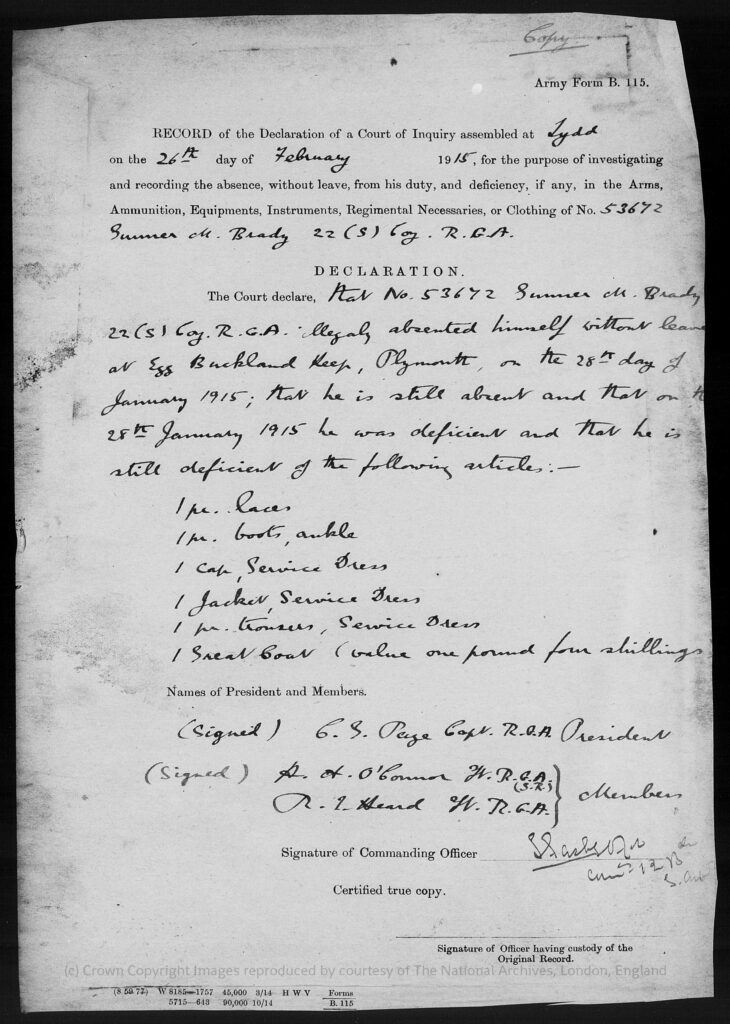
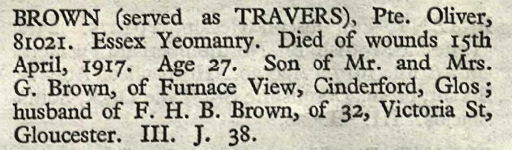 Oliver Brown was born in Cinderford in July 1890, the son of George and Mary Brown. He worked as a labourer and a miner in several collieries in the East Dean area. He volunteered in March 1915, but in September 1915, he deserted and disappeared. He somehow managed to survive clandestinely for over a year. He turned up later in Colchester, enlisted under the name of Travers and was killed in action in April 1917.