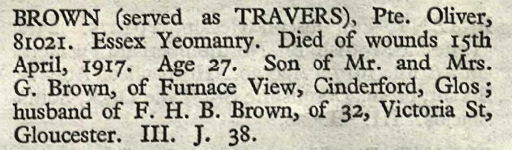
 Oliver Brown was born in Cinderford in July 1890, the son of George and Mary Brown. He worked as a labourer and a miner in several collieries in the East Dean area. He volunteered in March 1915, but in September 1915, he deserted and disappeared. He somehow managed to survive clandestinely for over a year. He turned up later in Colchester, enlisted under the name of Travers and was killed in action in April 1917.
Any soldier serving under a fictitious name was committing an offence called fraudulent enlistment. This includes men who lie on their attestation forms about having previously been in the armed forces. However, only about 2000 men faced a tribunal for fraudulent enlistment.
In its project Alias, the Western Front Association has studied the existing pension records cards for World War One soldiers and discovered that about 10 000 soldiers killed in the war had pension cards which revealed they were serving under a name other than their own. Sometimes the records reveal that these men had a history of using several names and had enlisted in several different regiments.
This is only the tip of the iceberg, as the pension records only list casualties who had dependents who were able to claim a pension. The unknown figure, which includes those men serving under a name other than their own who survived the war and those who were killed during the war without dependents, must be very much higher than this.
Men had a range of reasons for enlisting under a false name. Deserters, for example, might rejoin in a different regiment to escape difficult circumstances such as conflict with officers, bullying, or dissatisfaction with where they were deployed. Some may have left temporarily due to personal or family issues and then enlisted elsewhere to avoid punishment for desertion, or because they found life on the run unsustainable. In other cases, individuals moved between branches of service, such as from the army to the navy, or vice versa.
Project Alias
Project Alias has produced some quite revealing findings about soldiers who served under names other than their own, and it shows this was both more common and more complex than previously understood.
1) The scale of alias use was much larger than expected
Before the project, the Commonwealth War Graves Commission had identified about 3,500 soldiers who served under an alias.
- Project Alias expanded this to nearly 10,000 individuals
- That’s roughly a 300% increase in known cases
This demonstrates that serving under a different name was not rare—it was a significant phenomenon in the First World War.
2) Many soldiers effectively had “dual identities” in records
The research found that:
- Soldiers often had two parallel sets of records—one under their real name and one under the alias
- In some cases, records were split across systems, meaning no single search would reveal the full service history
Project Alias addressed this by linking both identities so researchers can now find all records regardless of which name is used.
3) Not all “different names” were true aliases
A key finding is that multiple names don’t always mean deliberate deception. The project identified several categories:
- Genuine aliases (intentional false names used at enlistment)
- Spelling variations or clerical errors (e.g. “McKay” vs “Mackie”)
- Administrative corrections (names altered later by officials)
- Ambiguous cases where it’s unclear if it’s an alias or an error
So, the raw numbers include a mix of true aliases and record inconsistencies.
4) Evidence of alias use is often embedded in official records
Project Alias confirmed that:
- Pension records frequently include both real and alias names
- Some explicitly state “alias” or “served as”
- Others only hint at it (e.g. crossed-out names, “see also” references)
This means many aliases were known to authorities at the time, but not systematically indexed.
5) Some individuals used more than one alias
While less common, the project found cases of:
- Soldiers with multiple alias names
- Complex identity trails across several documents
This further complicates tracing individuals without cross-referenced data.
6) The findings highlight unresolved historical questions
Although Project Alias identified the names, it also raised new questions:
- Why did so many men enlist under false names?
- How many cases remain undetected (e.g. if the alias was never recorded)?
The Western Front Association itself notes that the motivations behind alias use are still an area for further research.
Project Alias shows that serving under a different name in WWI was:
- Widespread (far beyond earlier estimates)
- Often traceable but poorly indexed
- Not always intentional—sometimes administrative or accidental