Henry Thomas Parry was born in Newnham in July 1880, the son of a blacksmith, Frederick Parry. In July 1874, Frederick was sentenced to one month’s hard labour for the theft of a florin. In 1876, Frederick was prosecuted for failing to maintain his wife and child, who were inmates of the Westbury workhouse. The couple had only been married for one year. He was ordered to pay 6s a week.[1]
In time, Frederick’s neglect and violence increased. He became a habitual drunkard and he repeatedly assaulted his wife. As a result, he was often up before the local magistrates. It is quite possible that he also abused his children. In November 1889, Frederick Parry assaulted his wife so badly that she was seriously injured and forced to leave their house and enter the workhouse with her children.[2]However, by 1891, the family were living together again.
Possibly because of the violence from his father, by the age of sixteen, Henry had left home and ended up living in London. In August 1896, he was in Pentonville prison serving one month’s hard labour for theft of a travelling bag.
Henry joined the Pembroke Artillery Militia in 1898. The British Militia was the principal military reserve force for internal security duties and for defence against external invasions. It was made up of non-professional soldiers who signed on for a term of service, which committed them to serve for training or duty if called up.
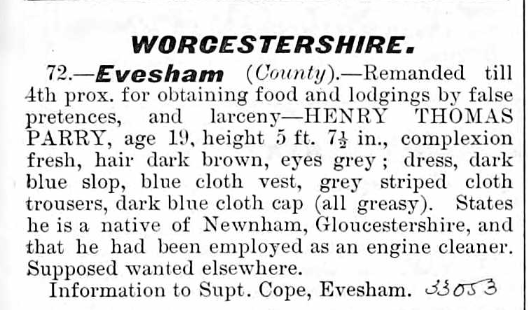
Henry deserted on 15 May 1899 and went on the run, surviving by committing a series of crimes and was usually described in his criminal records as of no fixed abode. His prison records also describe him as a fireman, a stoker or a labourer and so, between 1902 and 1907, he may have gained some work working on the railways or in shipping.
| Place of Conviction | Date | Offence | Sentence |
| Marylebone | 19/08/1896 | Theft of a travelling bag | One month’s hard labour in a prison |
| Evesham | 4/07/1899 | Theft of a watch | Two months’ hard labour in a prison |
| Blackwood | 8/09/1899 | Theft of a watch and chain | One month’s hard labour in a prison |
| Glamorgan | 17/03/1900 | Theft of watches (3 charges) | 9, 9, 9 months’ hard labour in a prison concurrently |
| Newport | 17/12/1900 | Theft of trousers and watches, etc (2 charges) | 3, 3 months’ hard labour in a prison concurrently. |
| Newport | 02/09/1901 | Theft of 2 watches, etc | 6 months’ hard labour in a prison |
| Cardiff | 17/10/1901 | Theft of clothes, purse and money | 12 months’ hard labour in a prison. Concurrent with the above. |
| Newport | 13/02/1907 | Obtaining food and lodgings by false pretences (3 Charges) | 3 months’ hard labour in a prison |
| Gloucester | 21/10/1908 | Theft of a cycle | 6 months’ hard labour in a prison |
Henry’s father died in July 1899. In the early 1900s, Parry started a relationship with Eliza Brown from Awre, who already had a child, Ernest, born in 1899. They had three illegitimate children: Gladys, born in 1902 in London, Ivor, born in 1908 in London and Lily, born in 1913 in Yorkshire (when Parry was described as a painter).
Parry was unable to support his family while in prison. He was admitted to Chepstow workhouse on 24 January 1908. In 1911, he was back in Newnham and living with his mother and siblings, but listed as married and as a labourer. At this time, Eliza was living in a house in Newnham with Gladys and Ivor and was described as single and working as a charwoman. In 1912, Eliza, Gladys and Ivor were admitted to the workhouse.
In 1914, Parry was living with Eliza and the three children in Barry and working as a marine stoker. On 8 December 1914, Parry joined the 16th Battalion, Welsh Regiment. However, he was discharged on 21 January 1915 because the military authorities deemed that he was unlikely to become “an efficient soldier”.
He married Eliza Brown on 24 October 1915. It appears that at some point he rejoined the army as a member of the Royal Engineers Inland Waterways Transport Corps.
https://www.longlongtrail.co.uk/royal-engineers-inland-waterways-transport/
However, on 27 February 1917, Henry Parry, a stoker from Newnham, was listed as a deserter in the Police Gazette.
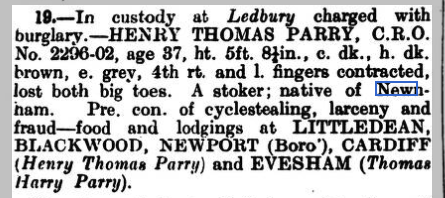
A few weeks later, he was arrested and charged with burglary and theft of £8. He was described in court as a well-dressed man living on City Road in Bristol. When he was arrested, he said:
“What? Breaking in; I know nothing about it.”
He was brought before the magistrates the next day and further remanded to appear at the next Quarter Sessions. He told the bench that:
he was very sorry. He had been working at Bristol but, wanting a change, he went to Ledbury with the intention of going to Hereford to work. He was invalided home several times, and had been put on as a substitute. He said that he would do all in his power to pay the lady back. He had been drinking heavily from the Saturday till the Tuesday night.[3]
At Hereford Quarter sessions, he was bound over to come for judgment within 12 months if called upon. The military authorities undertook to take charge of him.
It is unclear if he survived the war. However, a Henry Thomas Parry, born in 1881 in Gloucester, signed on the merchant navy in 1929. It is unclear if this is the same man.
In 1921, Eliza was living with Ivor and Lily near Ledbury and described as married as a charwoman. She died near Ledbury in January 1939. Her son Earnest gained work as an Air Ministry policeman but then joined the Royal Navy during World War Two and was killed at sea in 1940. Gladys worked as a domestic servant. Ivor joined the Royal Navy in 1926 and served during World War Two. Lily worked in a factory near Ledbury.
[1] Gloucester Citizen 27 September 1876.
[2] Gloucester Journal 23 November 1889.
[3] Worcester Journal 24 March 1917.