The story of David John Williams was brought to public attention in the Forest of Dean by local historian Steve Cooper, following his research into the local newspaper archives. During his investigations, Cooper uncovered a report of a military funeral held at All Saints’ Church, Viney Hill, in 1921. Further research by Cooper and fellow historians Eric Nicholls, Roger Deeks and Andrew Gardiner revealed a story of a forgotten soldier, who they believed to have died while trying to return to the Forest to see his newborn child. The story was reported in the Forester newspaper by journalist Nial Anderson.
Roger Deeks investigated further and wrote up details of the life and death of David Williams in an article in the Journal, Bugle and Sabre, Military History in Oxfordshire and Buckinghamshire, called A Forgotten Soldier: Private David Williams, in 2010.[1] Thanks to the work of these historians, Williams received a Commonwealth War Graves Commission headstone located in the All Saints Church.
The following is a summary of David Williams’s life, which draws on Deek’s article and Williams’s army records, birth and marriage certificates, census forms, etc., on Ancestry and other sources listed in the footnotes.
Early Life
David Williams was born on 25 June 1887 in Joys Green near Lydbrook, the son of a colliery carpenter. After leaving school, he obtained work as a collier and also qualified as a colliery carpenter.[2] However, since childhood, he suffered from severe asthma and working in the damp and dusty environment of a colliery would have made his condition much worse.[3]
On 25 July 1905, Williams chose the other main option for young working-class Foresters at the time and enlisted in the Gloucestershire Regiment (Glosters). He was just 18 years old and was 5 ft 4 in height and weighed less than 9 stone.[4]
India Colonies
In February 1908, Williams was posted to India, serving with the 1st Battalion Glosters, whose role was to maintain imperial commitments and uphold the British presence in key strategic locations. [5] The 1st Battalion was stationed primarily at Trimulgherry from 1903 until 1911, where it conducted standard infantry training amid the subcontinent’s garrisons. The death penalty was used to maintain military discipline, particularly against British soldiers of Indian heritage. Military prisoners were held in Trimulgherry’s notorious military prison.
The prison was built in 1858, soon after the attack on British seats of power across the subcontinent. Primarily designed to punish British-Indian soldiers, but also holding soldiers of British heritage, its gothic architecture, solitary cells, and gruesome gallows reveal how the British Empire kept a grip on dissent and punishment. Records show that nearly 500 people were executed at the prison.[6]
British soldiers were forced to watch the executions and so Williams probably would have been a witness to the barbaric spectacles. The execution of British soldiers in public in India was causing concern at home and was raised in parliament by Hugh Lea, the MP for St Pancras East, on 16 July 1906:
I beg to ask the Secretary of State for India whether he is aware that a public execution of a private in the 1st Lincolns took place between the prison and the cemetery at Trimulgherry on September 1st last; that the station orders issued by Brigadier General E. O. F. Hamilton, C.B., commanding Secunderabad and Bolarum, on that occasion required the attendance of detachments of every corps, British and native, in the station; that the scaffold was erected a few hundred yards from a public roadway and in view of the windows of the cell in which the man was lodged prior to his execution, and that in the walk from the prison to the scaffold he had to pass through crowds of natives and white women and children assembled to see the execution; and will he say what action he proposes taking in the matter.[7]
The soldier they hung was called Walter Smith. On 28 May, he got drunk and shot his sergeant major, proclaiming, “I shot the rascal. I meant it. He won’t get on to me anymore.”[8]
Malta
In October 1910, Williams was posted to Malta with the 2nd Battalion Glosters, focusing on fortifications and colonial security.[9] Britain was naturally aware of Malta’s strategic value as a military base, and had gained full sovereignty of the island through the 1814 Treaty of Paris.
On three separate occasions, during this period, Williams was promoted to Lance Corporal, but on each occasion, he was later reverted to the role of private as a result of misconduct.[10]
In April 1913, Williams was posted back to the UK, and on 25 April 1913, he was transferred to the Reserve. His army record describes his conduct as very good with no instances of drunkenness in his nearly eight years of service.[11] In April 1914, he married Fanny Hughes in Viney Hill and settled in nearby Yorkley.[12]
War
The British declared war on Germany on 4 August 1914, ostensibly because Germany refused to remove troops from neutral Belgium. The next day, Williams was mobilised and posted to the 3rd Battalion Glosters in Horfield, Bristol. This Battalion was a Special Reserve battalion and one of its main tasks was training and supplying reinforcements to front-line battalions.
Williams landed in France on 27 August 1914 with other reinforcements to join the 1st Battalion Glosters at Marne on 5 September, when the Battalion was made up of 26 officers and 970 other ranks. Williams was to suffer frequent asthma attacks while in the trenches, a problem which repeated itself throughout his active service during the First World War.
The First Battle of Ypres
On 16 October 1914, the Battalion was moved to join the first battle of Ypres. On 19 October 1914, the Battalion played a pivotal role in the defence of Langemarck, and was called upon several times to counter-attack against enemy breakthroughs. On 23 October, the Glosters, exposed on one flank, were attacked again and again, but beat off every fresh attempt, often in involved fighting at very close quarters.[13]
On 24 October, over 1500 bodies of German troops were counted in front of Langemarck. It is estimated that the German total loss in that sector for the previous three days of fighting was around 10,000 killed, wounded or taken prisoner, some of them child soldiers.[14] The battle continued and on 29 October, the Glosters Battalion, massively outnumbered, had 167 men killed, wounded or taken prisoner.[15]
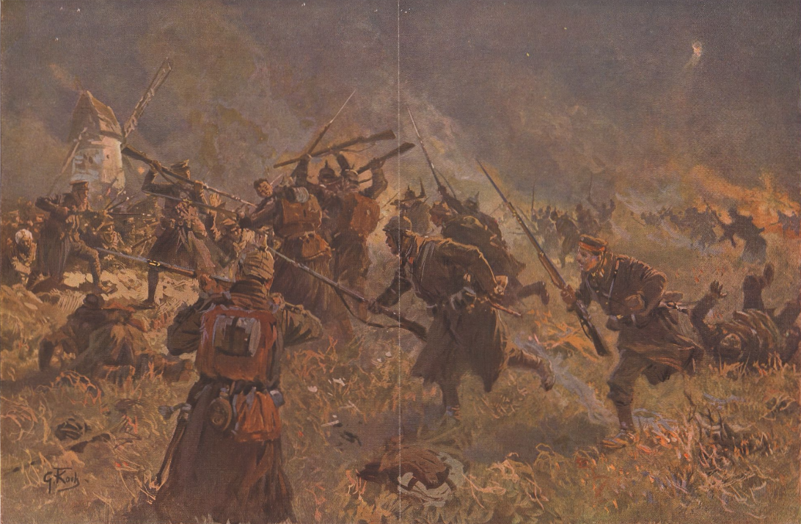
On 29 October 1914, Williams was injured with a wound to the left hand. On 9th November 1914, he was evacuated back to England for treatment.[16] Meanwhile, by 15 November, his battalion had been reduced to about 100 men. At the end of November, no side achieved significant breakthroughs at Ypres. The BEF suffered about 58,000 killed, wounded, and missing at the first Battle of Ypres between 14 October and 30 November with roughly 8000 deaths. The French had 30,000 casualties, the Belgians 20,000 and the Germans 130,000. Both sides settled into the trench warfare that would characterise the remainder of the war on the Western Front.[17]
Court Martial
On 26 December 1914, while Williams was posted to Horfield Barracks, his daughter, Esther, was born. She suffered from spina bifida and hydrocephalus and was very unwell. On 25 December 1914, Williams’s mother died.[18]
On 12 January 1915, Williams deserted, possibly because he wanted to see his baby daughter or attend his mother’s funeral or grave. He rejoined on 15 June 1915 and appeared before a court martial on 9 July, where he was sentenced to 112 days in a military prison with hard labour. However, the military was desperately short of men, and so his sentence was remitted and he was returned to duty on 21 August 1915.[19]
On 11 October 1915, his records show that he was given 28 days of detention, but no reason was given.[20] This may have been because he was about to be posted abroad and so may have attempted to desert again to see his daughter, who was still very ill.
Gallipoli
On 16 October 1915, Williams was sent to join the 7th Battalion Glosters at Gallipoli, where it had recently suffered terrible casualties, leaving 180 unwounded men from a Battalion strength of over 1,000 men. Among the casualties were a small number of men from the Forest of Dean, including the following soldiers from the 7th Battalion Glosters:
Frederick Brinkworth (Private) from Lydney was killed in action on 7 August 1915.
William George Davis (Private) from Lydney was killed in action on 8 August 1915.
James Emmanuel Shott (Private) from Littledean, died of his wounds on 11 August 1915.
Samuel Sayes from Ellwood was a member of the Royal Navy Nelson Battalion, an infantry battalion that fought on land at Gallipoli. He died of Enteric fever on 27 June 1915 while on a hospital ship on the Aegean Sea between Turkey and Greece.
Also:
Thomas Cooper (Private) from Coleford and the 4th Battalion South Wales Borderers, died of his wounds on 10 August 1915.
The conditions at Gallipoli were appalling, with many soldiers suffering from dysentery and other bowel complaints. In the end, a total of 355 men from the 7th Battalion died at Gallipoli, with 180 of these being killed on 8 August alone. After the disastrous campaign, the Battalion was withdrawn to Suvla Bay to join newly arrived reinforcements, which included Williams. The conditions at Sulva Bay were very bad, with freezing cold nights. Consequently, on 2 December 1915, William suffered frostbite. He was not the only one because Harold Boughton remembers:
freezing weather made an already difficult situation worse – troops huddled together for warmth, but it was not enough. Some died and many suffered frostbite. I saw men crawling on their hands and knees and grown men crying like babies. They had to crawl down the beach and the only medical attention down there was a large marquee with a red cross on it.[21]
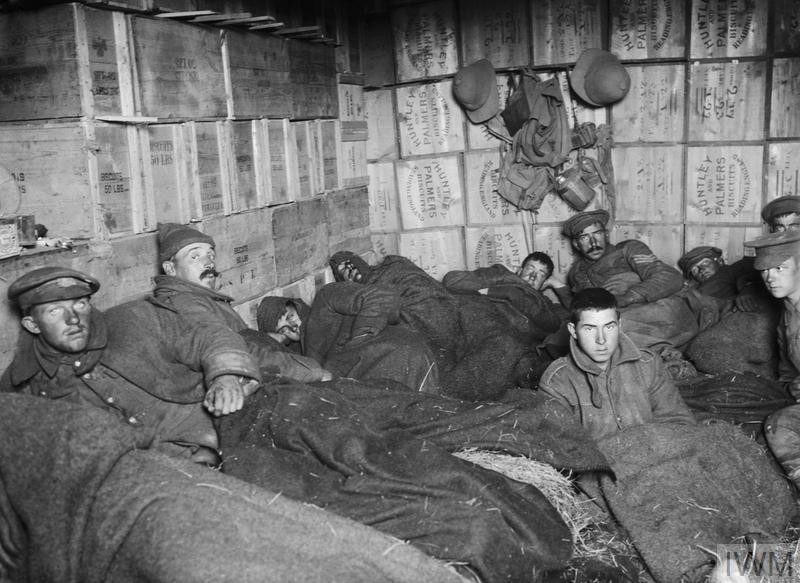
On 3 January 1916, Williams was sent back to the UK for treatment and was posted to 3rd Glosters on 21 January 1916.[22] He discovered that while he was at Sulva Bay, on 7 November 1915, his daughter, Gladys, died. It is not known if he was given time to travel from Horfield to visit his wife and his daughter’s grave.
Executions
During the Gallipoli campaign, 101 men were sentenced to die under the British Army Act, but in only four cases was the punishment confirmed and carried out. In two of the cases, the victims claimed to have been very ill. This was quite likely to be true because sickness among the troops was common due to the conditions.
Private Thomas Davis from the 1st Battalion, Royal Munster Fusiliers was executed on 2 July 1915 for leaving his guard post at Cape Helles in June. During his trial, he claimed that a bowel complaint had meant he had to visit the latrines.
Private Harry Salter from the 6th Battalion, East Lancashire Regiment, was executed on 11 December 1915 for deserting at Suvla Bay in November while waiting in reserve.
Private Patrick Downey from the 10th Irish Division was executed on 27 December for disobeying an order.
Sergeant John Robbins from the 5th Wiltshire Regiment was executed on 2 January 1916 after refusing to attend a night patrol on the basis that he was too sick.[23]
Battle of The Somme
On 11 March 1916, Williams was posted back to France to join the 10th Battalion, Glosters.[24] It would not be long before he would be in action at the Battle of the Somme. The Glosters were fortunate not to have been in action on the first day of the Battle on 1 July, when the British Army lost over 19,000 men killed and another 40,000 wounded. However, on 4th July, the Battalion joined the Battle. On the 9th of July 1916, Williams’s battalion was fighting in and around Albert and the following day they were in battle north of Fricourt.
On 12 July 1916, Williams received a severe gunshot wound to the face, hand and shoulder. He was returned to the UK and arrived on 16 July 1916 for hospital treatment in Cardiff.
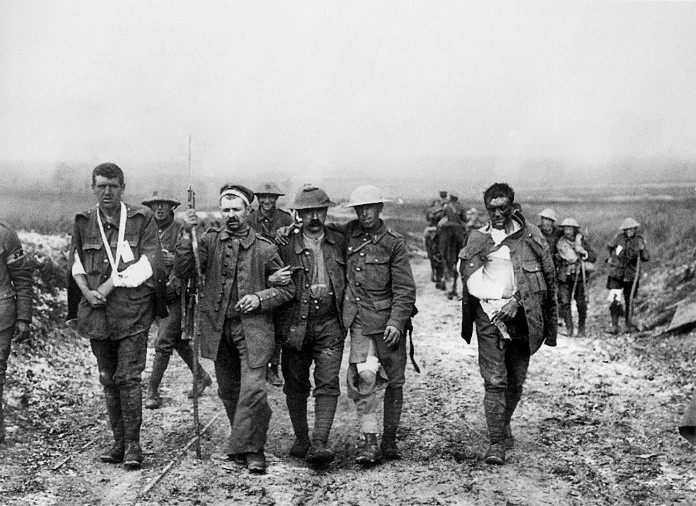
In July 1916, Williams’s father died, but it is not known if he was well enough to attend the funeral.[25] Williams remained in hospital for two months before returning to Horfield Barracks.
The Battle of the Somme lasted until November 1916 and resulted in over one million total casualties (killed, wounded, or captured) across all sides, with roughly 300,000 to over 400,000 estimated deaths.[26] Seventy-nine men were executed by the British army during the Battle of the Somme, the majority for desertion.[27] These men were viewed as expendable by the military commanders and the main function of their executions was to serve as a warning to others.
Back in Britain
However, desertions continued, particularly on the home front. Back in Horfield, on 25 September 1916, Williams deserted again but rejoined on 11 October 1916. However, there is no record of any disciplinary action. Despite his desertions, his character is described as sober and good in his records.[28]
On 8 January 1917, Williams was transferred to the Reserve and classified as no longer physically fit for service, mainly due to his asthma. He had served for over 11 years in the military.[29] He returned home to Yorkley and at last could spend some time with his wife. On 28 Feb 1917, the couple had a son, Stanley David Williams.[30]
In 1918 and 1919, coal was still in short supply and there was a shortage of skilled labour to work in the pits. Williams may have been able to return to work at his old colliery if he wished, but he suffered badly from asthma and so probably did not want to return to the pits, where his recovery and health would have been at risk. Other employment may have been difficult to obtain, as returning soldiers competed for jobs
Ireland
Consequently, on 4 December 1919, Williams re-enlisted and joined the 1st Battalion Oxfordshire & Buckinghamshire Light Infantry, which was then serving in Ireland.[31] In the early months of 1920, the 1st and 2nd Battalions, Oxford & Bucks, were stationed at Limerick and Cork respectively. They garrisoned the towns and sent out patrols to outlying towns and villages. As the year went on, Williams was thrown into the centre of a bitter and brutal conflict with revenge killings, assassinations, and reprisals on both sides.
In December 1920, the British authorities declared martial law in much of southern Ireland, and the centre of Cork city was burnt out by British forces in reprisal for an ambush. Violence continued to escalate over the next seven months; 1,000 people were killed and 4,500 republicans were interned. The British army committed atrocities against Irish civilians, and there were reprisals by the IRA.
Executions
On February 22, 1921, the bodies of three British soldiers were discovered by a farmer on the Woodford to Cahir Road near the shores of Lough Attorick. The three soldiers had all been shot in the head. One of them had a label hung around his neck which read “Spies. Tried by court-martial and found guilty. All others beware.” All three were members of ‘B’ Company, 1st Battalion of the Oxford and Buckinghamshire Light Infantry, stationed at the Strand Barracks in Limerick City. One of these men was David Williams. The other two were William Walker and H. Morgan (his real name was Thomas Mullett). They were all dressed in civilian clothing. The British army assumed they had been executed by the IRA’s East Clare Brigade. The British immediately retaliated by murdering an Irish civilian and burning houses
However, there is some controversy about the circumstances of their deaths. Padraig OgÓ Ruairc says that the three men were arrested by the IRA on February 19th and that their bodies were discovered three days later.[32]
O’Halpin and Ó Corráin say that they went missing from Limerick on February 13th and that their bodies were discovered on February 22nd. However, they say that no IRA sources for these deaths have been traced.[33]
Tomás Mac Conmara quotes local sources and one BMH statement, which indicates that the killing of these three British Army soldiers may have been in revenge for the killings on Killaloe Bridge.[34] The killings on Killaloe Bridge refer to the execution of four young Irishmen by British Crown Forces on 16 November 1920. The victims who became known as the Scariff Martyrs were IRA Volunteers Alfred Rodgers, Michael ‘Brud’ McMahon, Martin Gildea, and civilian caretaker Michael Egan. The circumstances surrounding the killings on Killaloe Bridge were as follows.
On 16 November 16, 1920, British forces surrounded a house in Williamstown, County Clare, capturing the three IRA volunteers and Egan. The men were taken by boat to the Lakeside Hotel in Killaloe for questioning and were then marched toward the police barracks. At midnight on Killaloe Bridge (which spans the River Shannon between counties Clare and Tipperary), the men were beaten, tied together, and shot. The Crown forces claimed the men were shot while attempting to escape, but witnesses and subsequent investigations proved this was a fabricated cover-up for a deliberate execution.
Julian Putkowski agrees with Tomás Mac Conmara and argues that the killing of the three British soldiers may have been an act of revenge. He points out:
There’s no indication about exactly when they were shot (Coroner guesses 19 February) but the British Army was not informed about the whereabouts of their corpses for at least two or possibly three days.
Spies, deserters or kidnap victims
There are several theories about what these men were up to before they were captured by the IRA. There are three possibilities.
- They were involved in an intelligence operation
- They were deserters.
- They were kidnapped.
Spies
Pádraig Óg Ó Ruairc argues that the men were engaged on an intelligence gathering mission for the British Army in North East Clare and captured and executed as spies by members of the IRA’s East Clare Brigade. This was not an unusual occurrence. There were other cases in which British spies dressed as deserters were captured and executed by the IRA. However, the British tended to use members of their officer class for such operations.
Ó Ruairc argues that it is difficult to regard the men as deserters. He points out that had they been deserters, they would have tried to return to England. He adds that the three soldiers could easily have walked to Limerick railway station, taken a train to Dublin, and then boarded a boat to England. Instead, they headed into the hostile and remote territory of Clare, widely known as an IRA stronghold, which seems illogical. The journey was more than 40 miles, and they would also have needed to evade army and RIC patrols along the way.
He points out that British army records show that the three soldiers were paid up to February 22, 1921, the day their bodies were discovered. This would have been standard practice for serving soldiers killed on duty, but deserters would have been paid only till 13 Feb, when they deserted.
He adds that Lieutenant John Basil Jarvis, who served as an intelligence officer with the Oxford and Buckinghamshire Light Infantry at the Strand Barracks, had a reputation for being reckless and may have taken the risk of sending these men on a very dangerous intelligence mission on the basis that they were experienced soldiers.
He presents this case in his online article, which should be read to follow the narrative presented here. The article provides background information about desertion by British army soldiers during the Irish War of Independence.
Deserters
Roger Deeks disagrees with Ó Ruairc, pointing out that these men were ordinary privates and unlikely to be chosen to carry out intelligence operations. In addition, Deeks argues that there is more compelling circumstantial evidence for believing that the men had deserted. He reports that Steve Cooper discovered that Williams had a son, Keith, who was born on 19 May 1920. The birth of his son may well have provided a motive to desert and return to Britain, as he may have deserted before for a similar reason.
Julian Putkowski has pointed out that both Williams and Morgan (Mullett) had a history of desertion. This fact further supports Deeks’s theory. Mullett’s war records reveal that he appeared before a district court martial at Woodbridge, Suffolk, on 9 March 1915 for being absent without leave. He was sentenced to 56 days in military detention but only served 14 days. On 23 October 1915, this report appeared in the Windsor, Eton & Slough Express:
Henry Morgan alias Thomas Mullett, 26, of the 3/4th Suffolk Regiment, was brought up on remand charged with being an absentee from the 3/4th Suffolk Regiment from October 4th. He was also charged with being a deserter from the 1/1st Essex R.H.A. since July 23rd. Inspector Hammond said a reply had been received from the Commanding Officer of the Suffolk Regiment asking that the prisoner be handed over to an escort, and the Inspector added that the escort was in attendance. Prisoner was ordered to be handed over to the escort.
No record of his punishment exists. However, there is a Henry Morgan from the Labour Company, based at Le Havre, who went absent without leave from 2 November 1917 and was sentenced to 56 days, but served 14 days. Given Williams’s and Mullett’s history of desertions, it is unlikely they would have been entrusted with an intelligence operation in such difficult circumstances.
William Walker also had a motive to desert. He had only recently married in August 1919 to Margaret Jessett and, at the time of his death, had a nine-month-old baby daughter, Doris.
Kidnap Victims
Putkowski suggests an alternative possibility for the three men’s disappearance:
They were reported missing on a Sunday, and may very well have been nabbed on Saturday night – when it’s quite plausible that the three could have gone out together for a drink and been captured by the IRA. Even for a dumb-arse Intelligence Officer like Jarvis, it would have been mega-stupid to dispatch three British squaddies (certainly not “of the officer class”) in civilian clothes to reconnoitre, let alone spy on local inhabitants or kid himself they’d not be killed off by the IRA.
Viney Hill
David John Wiiliams was buried at All Saints Church, Viney Hill, on 28 February 1921. Recent research has not been able to find the grave, but thanks to the Forest historians, he now has a Commonwealth War Graves Commission headstone in the graveyard.
In January 1924, Fanny married a miner from Yorkey, Thomas Parry, and they had a child, Joseph, in July 1924.[35] Sadly, Fanny had to endure another tragedy because in the same month that Joseph was born, Thomas was killed in a colliery accident. The following report appeared in the Western Daily Press on 14 July 1924:
A verdict of accidental death was returned by Mr M. F. Carter, Dean Forest Coroner, in the case of Thomas Parry (36), collier, who was killed at the coal face at Oldcroft Colliery, a small slant, on Tuesday. Parry, was clearing the floor of coal in order to erect a prop when two tons of stone fell on him, death being instantaneous.
In January 1929, Fanny married Edgar Hughes, a miner from Newport. The family, including Stanley, Keith and Joseph, moved to Abecan where Edgar worked as a colliery onsetter. Fanny died in October 1963.[36]
[1] Roger Deeks, Bugle and Sabre, Military History in Oxfordshire and Buckinghamshire, Oxfordshire: Lightmoor Press, 2010, 31-33.
[2] Ancestry
[3] His asthma is highlighted in his army records on Ancestry
[4] Williams’s Army Records
[5] Ibid.
[6] Deccan Chronicle 4 September 2021.
[7] Hansard, Executions of British soldiers in India, 16 July 1906
[8] Walter Smith was born in Swadlincote, a mining town in South Derbyshire. On leaving school at 13, he left home and worked as a collier. He joined the 4th Derby Reserve Regiment on 7 January 1899, when he was 19 but only 5 ft 3 in tall. He deserted on 29 January 1899, but was back on duty several weeks later. By 1901, he was working as a farm labourer. He then enlisted with the Lincolnshires in October 1902. He spent a period in South Africa, where he was convicted at a court martial of assaulting a sergeant and sentenced to 6 months in a military prison doing hard labour. He was transferred with the Regiment to India. Thanks to Julian Putkowski
[9] Williams’s Army Records
[10] Ibid.
[11] Ibid.
[12] Ancestry
[14] https://www.malvernremembers.org.uk/war-diary-entry/1st-gloucestershire-regiment-20th-23rd-october-1914
[16] Williams’s Army Records
[18] Ancestry
[19] Williams’s Army Records
[20] Ibid.
[21] https://www.iwm.org.uk/history/first-world-war/gallipoli/harold-boughton
[22] Williams’s Army Records
[23] Julian Pukowski and Julian Sykes, Shot and Dawn,(London, Leo Cooper, 1992) 56-59
[24] Ibid.
[25] Ancestry
[27] Pukowski and Julian Sykes, Shot and Dawn,
[28] Williams’s Army Records
[29] Ibid
[30] Ancestry
[31] Ibid.
[32] Padraig Og O Ruairc, Blood on the Banner: The Republican Struggle in Clare, 2009, 230-231.
[33] Eunan O’Halpin and Daithi O Corrain, The Dead of the Irish Revolution, Yale University Press, 2020, 311.
[34] Tomás Mac Conmara, The Scariff Martyrs: War, Murder and Memory in East Clare 187-188.
[35] Ancestry.
[36] Ibid.